Freestanding pieces
Custom coffee tables made in Adelaide
A custom coffee table in Adelaide costs $1,200 to $4,800, and most land between $1,800 and $2,800. Build time is 5 to 9 weeks. The table gets designed against the sofa, not against the room: 2/3 of the sofa length, within 50mm of the seat height, and 400mm to 450mm of walkway in front of it.
This is the piece people most often buy off a showroom floor and regret, because the standard 1,200 x 600 x 450mm retail table suits a sofa almost nobody owns any more. Below is the sizing maths, what each type of top costs, and the slab question that decides whether the table survives its first February. For the wider price picture read what custom furniture costs in Adelaide. If the slab look is what you are after, recycled and reclaimed timber is worth understanding first, and a coffee table is often commissioned alongside a dining table so the 2 pieces come out of one timber pack.
Sizing
The table is sized to the sofa, not the room
It comes down to 3 numbers: 2/3 of the sofa length, a height within 50mm of the seat cushion, and 400mm to 450mm of clear walkway in front. Get those right and almost any shape works.
| Sofa length | Table length | Shapes that work | Gap to sofa |
|---|---|---|---|
| 1,800mm (2 seater) | 1,100 - 1,250mm | Rectangle or 800mm round | 400mm |
| 2,100mm (2.5 seater) | 1,300 - 1,450mm | Rectangle or 900mm round | 400 - 425mm |
| 2,400mm (3 seater) | 1,500 - 1,650mm | Rectangle, oval or 1,000mm round | 425mm |
| 2,700mm (3.5 seater) | 1,700 - 1,850mm | Rectangle or oval | 425 - 450mm |
| L-shape with chaise | 900 - 1,100mm square or round | Square or round only | 450mm to both runs |
The height rule is where retail furniture fails hardest. A coffee table should sit within 50mm of the top of the compressed seat cushion, so you can put a cup down without reaching down. Sofas have got lower: the deep, low-slung style sold across Adelaide showrooms now sits at 340mm to 380mm, while the standard retail coffee table is still built at 450mm. That 80mm gap is why a new table can look right in the shop and wrong at home.
The 400mm to 450mm walkway is the other number worth defending. Under 400mm, nobody can get past the table without turning sideways. Over 500mm, you have to lean forward off the sofa to reach anything on it, which defeats the point of the table. If the room cannot give you 400mm at both ends of a rectangle, the answer is a round or square table, not a smaller rectangle.
Where an odd room genuinely forces a custom build
These 3 situations account for most custom coffee tables in Adelaide. The first is an L-shaped sofa, where a rectangle is wrong in principle and the right piece is a square or round top placed at the inside corner of the L. The second is a bay window or a chimney breast in a pre-1940 villa, which pushes the sofa off centre and leaves an asymmetric floor space that a standard rectangle cannot sit in without looking crooked. The third is a low-slung sofa, where the correct height simply is not manufactured at scale.
A fourth reason is less about shape and more about traffic. In an open-plan rear extension, the living zone usually sits on the path between the kitchen and the back door. A table with square corners in that path gets kicked. Rounding the corners to a 60mm radius, or going fully round, costs nothing extra at build time and removes the problem permanently.
Measure these 5 before you enquire
- 1.Sofa length, arm tip to arm tip, not the seat cushions.
- 2.Seat height, floor to the top of the cushion with someone sitting on it.
- 3.The clear floor between the sofa front and the TV unit or the far wall.
- 4.The narrowest doorway or hallway turn the finished table has to pass through.
- 5.Where direct sun lands on the floor at 3pm in January.
The top
Slab, glued panel, stone or veneer
On a coffee table the top is most of the cost and all of the character. These are the 4 real options and what each one does to a quote.
Glued solid panel
$1,200 - $2,000Boards ripped, re-oriented and glued into a stable panel, then squared. The cheapest honest solid top and the most predictable one, because alternating the growth rings cancels most of the cupping out before it starts.
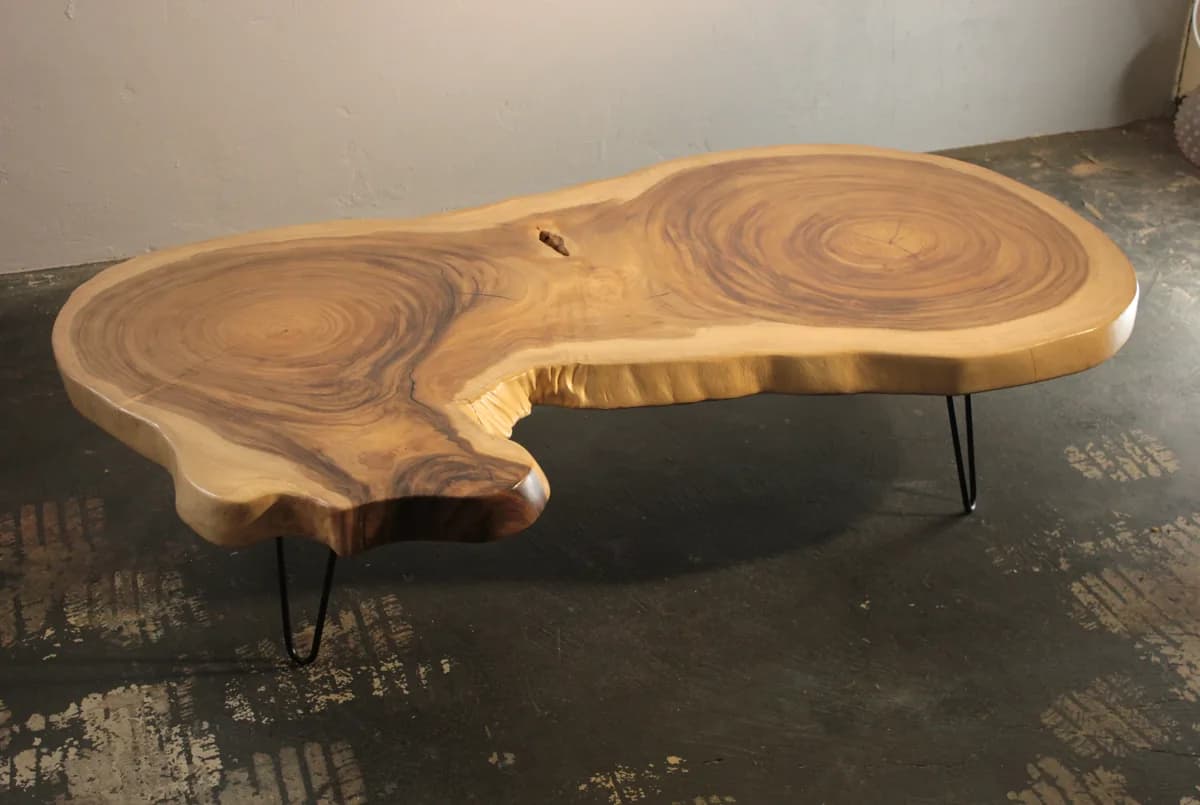
Live-edge slab
$2,400 - $4,800One board, both edges left as the tree grew. The slab is the cost, not the labour: buying it dry, flattening 60kg of timber and dealing with whatever the tree did internally. Every slab has a defect budget you inherit.
Stone or engineered stone top
Adds $900 - $2,400Travertine, marble or a sintered surface on a timber or steel frame. Adds 25kg to 45kg, which changes the base design entirely. It will not move with humidity, which is why a stone top on a solid timber apron needs a floating fixing.
Veneered panel
$1,100 - $1,900Timber veneer on ply or MDF. Flat forever, and the only sensible way to get a book-matched or quarter-cut figure across a wide top. The edge is the giveaway, so specify a solid lipping of at least 20mm so it can be sanded later.
Which species suits which of those is set out in our timber guide for Adelaide. River red gum is the species most Adelaide slab tables are cut from, blackwood is the one people choose when they want figure without the drama, and Tasmanian oak is the sensible glued-panel baseline.
The base
Blackened steel or timber legs
The base is 25% to 35% of the cost and it decides how the table behaves under load, so it is worth deciding early rather than last.
Blackened steel
A folded or welded plate base in 6mm to 10mm steel, blackened and clear-coated. Costs $600 to $1,400 fabricated. It is the correct partner for a heavy slab, because a steel frame can be slotted at the fixing points so the slab moves across its width without splitting, and it takes 60kg of top on a slim profile that a timber leg cannot match. Ask for the fixing slots to run across the grain, not along it. That single detail is the difference between a slab that lives and one that cracks.
Timber legs and frames
Costs $350 to $900 depending on the joinery. A tapered leg with a mortise-and-tenon rail is the traditional answer and it works, but on a coffee table the rails sit low and eat foot room, so the rail depth wants to stay under 70mm. A timber pedestal or a pair of sled legs keeps the whole floor clear, which matters more here than on a dining table because you put your feet on it.
The Adelaide question
Ask what the slab read on a moisture meter
A slab top is a single wide board, so it carries all of its movement in one piece with nothing to cancel it out. Adelaide punishes that harder than any other mainland capital. A living room running ducted refrigerated or evaporative cooling sits under 30% relative humidity for weeks through February, and timber in that room settles at 8% to 10% moisture content.
A slab sold at 14% to 16%, which is where air-dried stock usually sits, still has a third of its shrinkage ahead of it. It will lose that moisture in your living room over the first summer and it will open along the grain while it does. The fix costs nothing at order stage: ask what the meter read at machining, and ask when the slab came out of the kiln.
If a slab already has a check or a crack, there are 2 correct answers and 1 wrong one. The correct answers are bow-tie keys (also called butterfly keys), which are 8mm to 12mm inlays set across the crack to stop it travelling, and a stabilised fill in clear or tinted epoxy done after the slab has reached equilibrium. The wrong answer is filling a live crack in a slab that is still drying. The timber keeps shrinking, the epoxy does not, and the split reappears somewhere else on the top within a year.
The second Adelaide-specific issue is sun. A coffee table sits in the middle of the floor, which in a north-glazed extension is exactly where the light lands. Sapwood and pale river red gum bleach unevenly in a single summer, and the shadow of anything left on the table gets printed into the finish. A UV-inhibited hardwax oil slows it. Nothing stops it, so plan the table position against the sun rather than against the finish.
The full picture on how timber moves in a South Australian house is in why solid timber tables split in Adelaide homes.
Where a $2,400 slab table goes
$900 - $1,300
The slab itself, dried and selected, with 20% to 30% lost to flattening and edge work
$600 - $900
Steel base, fabricated, blackened and clear-coated
$400 - $700
12 to 18 hours flattening, filling, sanding to 320 grit and 3 to 4 oil coats
The rest
Consumables, workshop overhead, insurance and delivery
FAQ
Custom coffee tables in Adelaide: common questions
How much does a custom coffee table cost in Adelaide?
Between $1,200 and $4,800, with most landing between $1,800 and $2,800. A plain rectangular timber table on a glued panel top starts the range. A live-edge slab on a blackened steel base sits at the top of it, because the slab itself is often 40% of the build cost before anyone has picked up a tool.
What size coffee table do I need for my sofa?
Take 2/3 of your sofa length, arm tip to arm tip. A 2,400mm 3 seater wants a table 1,500mm to 1,650mm long. Go shorter and the table looks stranded in the middle of the room. Go longer and it fights the sofa for visual weight and blocks the walkway at each end.
How high should a coffee table be?
Within 50mm of your sofa seat height, measured to the top of the cushion with someone sitting on it. Most modern sofas sit at 400mm to 450mm, so a 400mm to 450mm table is right. The 450mm retail default is wrong for the low-slung sofas sold now, which often sit at 340mm to 380mm and need a table down at 350mm to 400mm.
Is a round coffee table better than a rectangular one?
Round wins wherever the walkway is tight or the room is not a clean rectangle. A round top has no corner to catch a shin, so it can sit 100mm closer to the sofa than a rectangle of the same footprint. An 800mm to 1,000mm round suits most Adelaide living rooms. Round costs 10% to 20% more than a rectangle of equal size because cutting a circle out of square boards wastes timber.
What does a live-edge slab coffee table cost?
$2,400 to $4,800 in Adelaide, depending on the slab. A dry, stable river red gum or redgum burl slab at 1,200mm to 1,400mm long is $900 to $2,200 before machining, and the waste and the flattening time are both higher than a glued panel. Add $600 to $1,400 for a blackened steel base.
Will a slab coffee table crack in an Adelaide house?
It will if the slab was not dried to the right moisture content first. Adelaide is the driest mainland capital, and a living room on ducted cooling sits under 30% relative humidity for weeks in February. A slab machined at 14% moisture content keeps shrinking indoors and opens along the grain. Ask for the meter reading at machining: 8% to 10% is what an Adelaide house wants.
Keep reading
You might also find this useful
- Which finish to put on a coffee tableA coffee table takes cups, feet and sunlight. The finish decides whether a mark is a 10-minute fix or a full re-sand.Read it
- Caring for timber furniture in AdelaideHumidity, north-facing glass and re-oiling intervals, which matter more on a slab top than on anything else you own.Read it
- Custom entertainment unitsThe piece that usually sits opposite the coffee table, and the one worth quoting at the same time from the same timber.Read it
Start here
Get your coffee table priced by Adelaide makers
Send us your sofa length, seat height and the shape you have in mind. We pass it to a local maker who does this work, and they quote you directly.
- Free to use. The maker may pay us a fee, you never do.
- Check the maker's ABN, insurance and completed Adelaide work before you commit.
- Adelaide metro only, so you are not sent to an interstate workshop.