Timber and materials/8 min read
Recycled timber furniture in Adelaide
Recycled timber usually costs more than new, not less. The reason is nail-strike, waste factor and the extra machining a reclaimed board needs before it is furniture.
Ready to price something specific? See timber furniture in Adelaide or coffee tables in Adelaide.
Recycled timber furniture in Adelaide costs 20% to 60% more than the same piece in new Tasmanian oak, not less. That is the opposite of what almost everyone expects, and it catches people out at the quote stage. Reclaimed boards are not free material, they are difficult material, and the premium is paid in labour, waste and destroyed tooling rather than in the price of the timber itself.
Where reclaimed sits against the rest of the field is set out in choosing timber for custom furniture. This page covers what it costs, where it comes from, and the 2 things to ask before you commit to it.
Why reclaimed costs more than new
There are 5 reasons, and they compound.
Nail strike. Old structural timber and old flooring are full of metal: nails, screws, staples, brads and the occasional bolt, much of it snapped off below the surface and invisible. A single hidden nail takes out a set of planer or thicknesser knives in an instant. Every board therefore goes through a metal detector, gets de-nailed by hand, and gets cut around where the metal cannot be removed.
Waste factor. New kiln-dried hardwood loses 30% to 40% to machining, defect and offcuts. Reclaimed loses 45% to 65%, because on top of the normal losses you also cut out nail holes, bolt holes, checks, splits, paint lines, rot and the worn face of a floorboard. You pay for all of it.
Extra machining passes. A reclaimed board is dirty, often twisted, and rarely flat. It needs a skim cut to expose clean timber, then the usual milling sequence, then more sanding than new stock because old fibre has hardened.
Tooling. Grit embedded in old timber, plus metal fragments, plus the silica in weathered surfaces, blunt cutters at several times the normal rate.
De-nailing labour. This is the invisible one. Preparing enough recycled flooring for a single tabletop is typically 3 to 8 hours of work before any furniture making starts.
The numbers, side by side
| Line item | New Tasmanian oak | Reclaimed Baltic pine | Reclaimed jarrah | | --- | --- | --- | --- | | Waste to defect and machining | 30% to 40% | 45% to 65% | 45% to 60% | | Metal detection and de-nailing | 0 hours | 3 to 6 hours per table | 4 to 8 hours per table | | Tooling and blade allowance | $30 to $60 | $120 to $250 | $150 to $350 | | Extra machining passes | 0 | 2 to 3 | 2 to 4 | | Typical lead time impact | none | 1 to 3 weeks | 2 to 4 weeks | | Net effect on the quote | baseline | +20% to 40% | +35% to 60% |
On a $4,000 table that is $800 to $2,400 of additional cost, and none of it buys a better-performing tabletop. It buys character, provenance and the fact that the timber already exists. Those are legitimate things to want. They are just not savings.
Where Adelaide's reclaimed timber actually comes from
Adelaide has an unusually large stock of pre-1940 villas, bungalows and cottages, and as they are renovated their timber enters the market. The supply is genuinely local, which is one of the better arguments for using it.
| Source | What it typically is | Condition | Best use | | --- | --- | --- | --- | | Cottage flooring | Baltic pine, some jarrah | 19mm to 25mm, tongue and groove, nail holes every 300mm | Laminated tops, shelving, panelling, drawer fronts | | Roof and floor joists | Oregon, messmate, mixed hardwood | 100 x 50 up to 250 x 75, very dry, occasional borer | Table bases, beams, thick tops | | Wharf, bridge and shed timber | Jarrah, ironbark, red gum | 150mm sections and up, bolt holes, checks, weathered | Slab tops, benches, outdoor settings | | Demolition hardwood flooring | Jarrah, blackbutt | 80mm to 130mm boards, worn face | Laminated tops, joinery, stair treads | | Commercial and institutional fitouts | Oregon, hardwood, occasional silky oak | Widest boards available | Feature tops, wide single-board panels |
Baltic pine deserves a specific warning. It is beautiful, warm and very soft, at roughly 1.9 to 2.5 kN Janka against 5.0 to 5.5 for Tasmanian oak. It dents under normal dinner service. Use it vertically as panelling, drawer fronts or shelving, and think hard before using it as a family dining top.
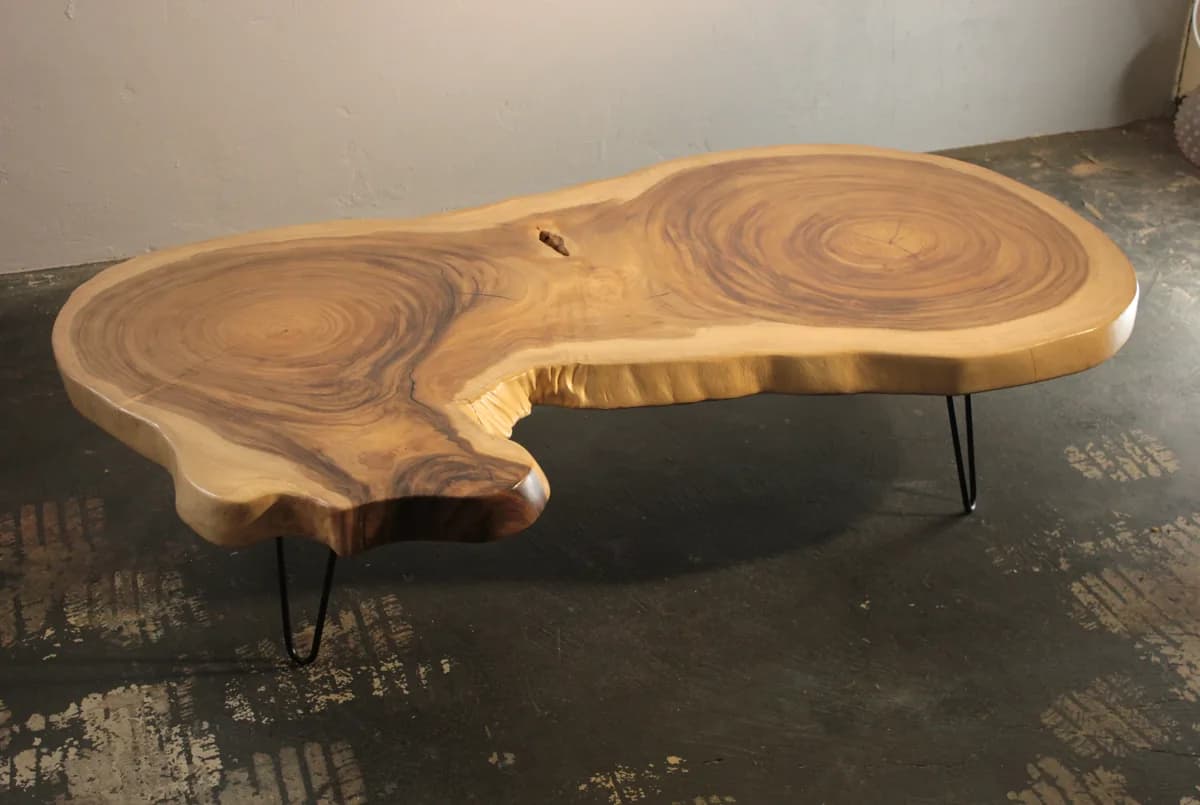
The heavier sections work in the opposite direction. Jarrah and red gum recovered from structural use are dense, dramatic and ideal as a thick slab, which is why so many custom coffee tables in Adelaide are built from them.
Hidden problem 1: residual moisture and movement
Age does not exempt timber from moisture exchange. This is the assumption that causes the most trouble.
Timber recovered from a roof space has sat in dry, sheltered air for decades and is genuinely stable. Timber recovered from a wharf, a bridge, a fence or an open shed has been sitting at outdoor equilibrium, and a thick outdoor section can be carrying a moisture content in double figures right through its core even when the surface reads dry.
Machine that into a tabletop, deliver it into an Adelaide house running refrigerated cooling, and it keeps shrinking, cupping and checking for its first year. Thick sections are the worst offenders, because a 75mm slab reaches equilibrium far more slowly than a 25mm board.
The fix is the same as for new timber and is not optional: the stock is stickered in a conditioned space and metered until the reading is stable, typically 8% to 12%, before anything is machined. For thick reclaimed slabs that is weeks, not days. The full mechanism is explained in why solid timber tables split in Adelaide homes.
Ask for the meter reading. An answer that relies on the timber being 90 years old is not an answer.
Hidden problem 2: old finishes and treatments
This is worth being factual and calm about, because it is manageable and it is frequently either ignored or dramatised.
Paint manufactured in Australia before 1970 commonly contained lead, and lead paint stayed in circulation for some years after that. Painted salvage, particularly skirtings, architraves, weatherboards and window joinery from pre-1970 houses, can carry it under later coats. Sanding or machining a lead-based coating produces fine dust, and that dust is the actual hazard rather than the intact paint film.
The handling is straightforward. Painted stock is tested before it is worked, coatings are removed by a method that does not create airborne dust, and dry sanding in an open workshop is avoided. Guidance for workplaces handling lead-containing materials in South Australia is published by SafeWork SA.
There are 3 other treatments that show up less often and are worth naming:
- Creosote and tar on old wharf, sleeper and pole timber. It smells, it bleeds through finishes, and it never fully leaves the timber.
- CCA and other preservative treatments on structural pine and outdoor stock. Treated pine should not be machined into indoor furniture.
- Old shellac, varnish and floor lacquer on flooring. Harmless, but it must be fully removed or a new finish will not key to the surface.
Unpainted structural hardwood and clear-finished flooring, which is most of the Adelaide supply, carry none of these issues.
What reclaimed is genuinely worth paying for
Set against the extra cost, there are 3 real advantages.
Character that cannot be manufactured. Nail holes, saw marks, bolt scars and 40 years of oxidation are not reproducible with a stain. A distressed new board looks like a distressed new board.
Dimensional stability, when the source is right. Timber that has been indoors for 80 years has done all the moving it is going to do.
Board width and species you cannot buy new. Old-growth jarrah, wide Oregon and single-board widths over 400mm are effectively unavailable in new stock at any sensible price.
If those matter to you, the premium is worth paying and you should go in expecting it. If what you actually want is the look at a lower price, a plainer new species finished well is the better trade, and the options are compared in blackwood versus Tasmanian oak and on the custom timber furniture page.