Timber and materials/8 min read
Blackwood versus Tasmanian oak for furniture
These 2 species account for most custom furniture built in Adelaide. They behave very differently, and one of them changes colour dramatically in its first year.
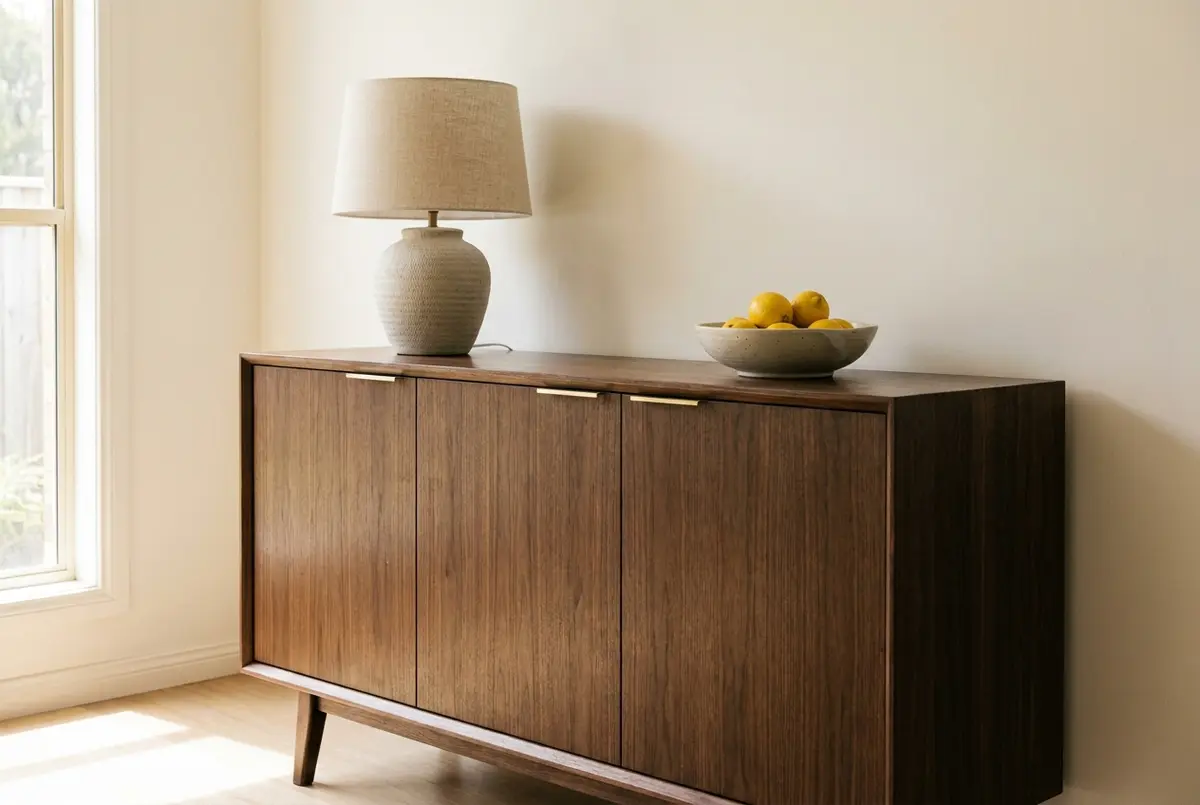
Ready to price something specific? See timber furniture in Adelaide or buffets & sideboards in Adelaide.
Blackwood and Tasmanian oak account for most custom furniture built in Adelaide, and they behave very differently. Blackwood costs 35% to 55% more, darkens 2 to 3 shades in its first year, and carries figure that Tasmanian oak does not. Tasmanian oak is pale, straight-grained, endlessly available and the cheapest of the genuinely good options. On hardness they are almost identical, which surprises most people.
The wider species field, including jarrah, marri and river red gum, is set out in choosing timber for custom furniture. This page is the direct comparison.
The comparison at a glance
| Property | Tasmanian oak | Blackwood | | --- | --- | --- | | Cost for the same piece | Baseline | +35% to 55% | | Janka hardness | 5.0 to 5.5 kN | 5.0 to 5.5 kN | | Colour when new | Pale straw to light pink-brown | Light golden brown | | Colour at 12 months | Ambers about 1 shade | Darkens 2 to 3 shades to red-brown | | Movement in service | Moderate, slightly higher | Low once properly dried | | Grain | Straight, even, occasional gum vein | Straight to wavy, fiddleback common | | Machining | Predictable, easy to sand | Tears out on figured stock | | Availability in Adelaide | Always, in volume | Available, variable for matched packs | | Best at | Large tops, matched runs, stained work | Feature pieces, doors, chairs, buffets |
Note that Tasmanian oak is a trade name rather than a single species. It covers several eucalypts, and Victorian ash is the same timber sold under a different name. Blackwood is a single species, an acacia rather than a eucalypt, which is why it looks and works so differently.
Colour, and what the first year does to it
This is the difference people notice, and it is the one that causes the most regret when it is not explained up front.
Blackwood oxidises fast. A freshly machined board is a light honey-gold with hints of pink. Within 12 months in an ordinary room, away from a window as well as near one, it moves 2 to 3 shades toward a warm mid red-brown. It keeps warming after that, more slowly, for years. Under oil the shift is immediate and dramatic: a raw sample and an oiled sample of the same board look like different timbers.
Tasmanian oak barely moves. It ambers gently, perhaps 1 shade across several years, and holds its pale character. That stability is precisely why it is used for stained and painted work: what you apply is what stays.
The practical rule follows directly. Choose blackwood 2 shades lighter than the colour you want to end up with, and view a finished sample rather than a raw one. Choose Tasmanian oak as the colour you want now, because it will still be roughly that colour in 5 years.
The exception on both is direct sun. Adelaide extensions are glazed heavily to the north, and unprotected timber behind north-facing glass bleaches unevenly within 1 summer. Blackwood has more colour to lose, so it shows the fade harder.
Hardness, and why the numbers mislead
Both species sit at roughly 5.0 to 5.5 kN on the Janka scale. That is a mid-range hardness by Australian standards, well below jarrah at 8.0 to 9.0 kN and well above recycled Baltic pine at under 2.5 kN.
Neither is a hard timber. Both will take a dent from a dropped saucepan and both will show a fork mark if you press hard enough through a placemat. Anybody promising a dent-proof dining table in either species is overselling.
What actually decides how a table looks in year 5 is the finish, not the species. A hardwax oil marks more easily and can be repaired at home in 20 minutes. A catalysed lacquer resists more and cannot be spot repaired at all. Reference data on Australian species hardness and movement is published by WoodSolutions.
Movement and stability
Blackwood is the quieter of the 2 in service. Once dried properly it is dimensionally stable, holds flat, and is a comfortable choice for wide panels and cabinet doors. Tasmanian oak has slightly higher unit movement and is more often used in wide flatsawn boards for large tops, which compounds the difference in practice.
Keep that in proportion. The gap between the 2 species is far smaller than the gap between good and bad construction. A blackwood top screwed rigidly through a fixed rail will open up in an Adelaide February; a Tasmanian oak top on buttons with slotted holes will not. The mechanism, the numbers and the questions to ask are in why solid timber tables split in Adelaide homes.
Figure, and what it does at the machine
Blackwood frequently carries figure: fiddleback, wave, and a shimmer that shifts as you move past it. It is the main reason people pay the premium, and it is also the reason figured stock costs more again.
Figured timber has grain running in alternating directions. A standard planer cut lifts and tears it. A maker working figured blackwood takes light passes, often uses a scraper or hand plane, and accepts more sanding time. Boards are selected individually rather than bought by the pack, so the waste factor climbs. Together that adds 20% to 40% on top of the species premium.
Tasmanian oak is straight and even. It machines predictably, sands quickly, and takes a stain uniformly. That consistency is not glamorous, and it is exactly why it dominates the market.
How each takes a finish
The finish decision is not independent of the species, and this is where the 2 diverge most usefully.
| Finish | On Tasmanian oak | On blackwood | | --- | --- | --- | | Hardwax oil | Warms it 1 to 2 shades, keeps texture readable, easy to repair | Excellent. Brings out depth and chatoyance in figure. The default choice | | Polyurethane | Practical, adds a slight amber cast, hard to spot repair | Acceptable, flattens the figure somewhat | | Catalysed lacquer | Very durable, clean and neutral, needs a spray booth | Suppresses the shimmer that justified the price | | Stain or wash | Takes it evenly and predictably. The reason it is used for stained work | Poor value. Staining blackwood wastes what you paid for |
The summary is short. Blackwood under oil is what blackwood is for. Tasmanian oak under any of the 4 is fine, which is a genuine advantage when a piece has to match something that already exists in the house.
Which one suits which piece
- Dining table, 2,400mm or longer: Tasmanian oak, unless the table is the centrepiece of the room and the budget carries the 45% premium across a large area. Cost scales with square metres, and this is where the premium bites hardest.
- Buffet or sideboard: blackwood. Door fronts are the perfect canvas for figure and sequential grain matching, and the area is small enough that the premium stays reasonable. This is covered on the buffets and sideboards page.
- Chairs: blackwood. It bends and holds a shaped component well, and chair components are small.
- Wardrobe or fitted joinery: Tasmanian oak or veneer. The areas are large, the doors are mostly closed, and figure is wasted behind a swing door.
- Bedhead or feature panel: blackwood, and this is the cheapest way to own some. A bedhead is 1 to 2 square metres.
- Anything to be painted or stained: Tasmanian oak, always.
If you want the same analysis applied across the rest of the field, including the reclaimed options and why they cost more than new timber, that sits in recycled timber furniture in Adelaide. Material selection by piece type is on the custom timber furniture page.