Freestanding pieces
Custom desks and office furniture in Adelaide
A custom desk in Adelaide costs $1,600 to $6,000, and most land between $2,200 and $3,600. Build time is 6 to 10 weeks. People order custom for 3 reasons: the alcove is a width nobody manufactures, the standard 720mm height is wrong for them, or the cables need to disappear properly.
Bespoke office furniture is the category where the specification matters more than the timber. Depth decides whether a monitor arm works. Height decides whether your shoulders hurt at 4pm. Cable routing decides whether the desk looks like the render. All 3 are set out below, with real numbers. Before you enquire it is worth reading how to brief a furniture maker, and what custom furniture costs here. A desk is very often quoted with a matching shelving run, which is cheaper as 1 job than as 2.
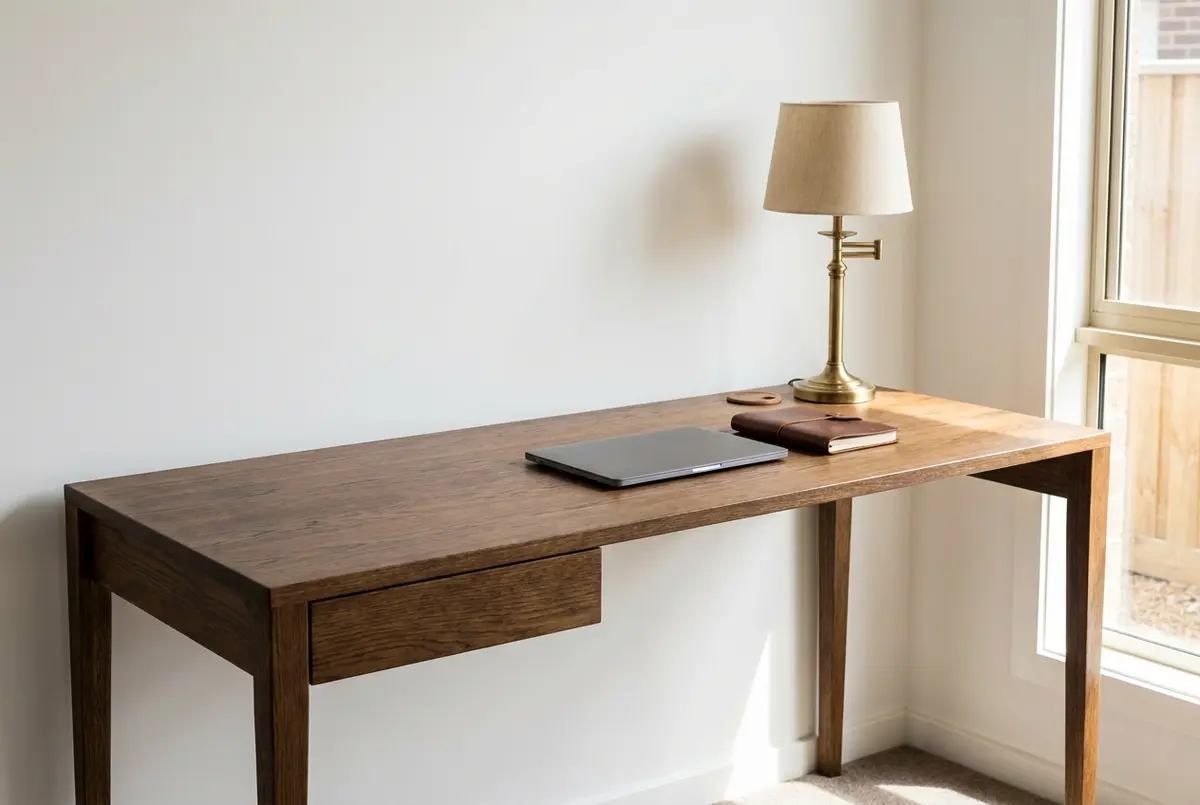
What it costs
The 5 build types, and what each one runs to
Desks price by complexity, not by size. A drawer box is 4 to 6 hours of joinery. An extra 300mm of top is about 40 minutes.
| Build type | Typical size | Adelaide cost |
|---|---|---|
| Alcove or wall-fit desk | 1,200 - 1,600 x 600 - 700mm | $1,600 - $2,600 |
| Freestanding writing desk | 1,400 - 1,600 x 700mm | $2,000 - $3,200 |
| Sit-stand: custom top on an electric frame | 1,600 - 1,800 x 750mm | $2,400 - $4,000 |
| Return or L-shaped desk | 1,600 x 1,600 x 700mm | $2,900 - $4,600 |
| Desk with matching overheads or a shelving run | Wall-length | $3,400 - $6,000 |
An alcove desk is the cheapest custom build there is, because the walls do the structural work. Just 2 cleats and a scribed top, with no legs and no frame, is 8 to 12 hours. It is also the build most worth doing custom, since an alcove is almost never a width you can buy: 1,340mm and 1,470mm are common in Adelaide bedrooms and neither exists in a catalogue.
A return desk (the L, with a shorter leg running back along a second wall) costs more than 2 straight desks would, because the corner has to be a single continuous top or a properly engineered join. Ask for a mitred or biscuited corner rather than 2 tops butted together with a visible seam, and check that the corner has its own leg or a wall cleat. An unsupported 1,600mm corner will deflect within a year under a monitor.
Where cabinet work is involved (drawer banks, filing, a printer cupboard) the job starts to look more like cabinet making than furniture making, and the quote should be broken out that way. Once it becomes a fitted wall of storage it is priced as joinery, per linear metre, and the numbers change again.
Height
The 720mm standard fits fewer people than you think
Every mass-produced desk sold in Australia sits at 720mm to 750mm. That is correct for someone 1,750mm to 1,850mm tall in a chair set at the right height, and wrong for everyone else.
| Your height | Seated desk height | Standing height |
|---|---|---|
| 1,600mm | 660 - 680mm | 950 - 1,000mm |
| 1,700mm | 690 - 710mm | 1,020 - 1,060mm |
| 1,800mm | 720 - 740mm | 1,080 - 1,120mm |
| 1,900mm | 750 - 770mm | 1,140 - 1,180mm |
A fixed desk also has to leave knee room. Allow 640mm minimum from the floor to the underside of any rail or drawer box, and keep the front rail depth under 80mm. A drawer slung under a 720mm top is the single most common reason a custom desk ends up unusable: the drawer box is 120mm deep, the clearance drops to 590mm, and your thighs hit it.
Sit-stand, honestly
No small workshop builds a lifting mechanism. What a custom sit-stand desk means is a custom top fitted to a commercial electric frame, and the frame is where the quality sits. A dual-motor frame rated to 100kg or more costs $700 to $1,400 and travels 620mm to 1,270mm. A single-motor frame at $350 to $600 is rated nearer 70kg, which a solid hardwood top eats most of before you put a monitor on it: a 1,800 x 750mm solid oak top at 32mm weighs 38kg to 45kg on its own.
Fitting matters as much as the frame. The top must be attached with threaded inserts or machine screws into the frame plate, never woodscrews driven straight into the underside, because the frame applies a shear load every time it travels. Add $250 to $400 for the maker to fit, wire and cable-manage a frame properly.
Cables and depth
The 3 details that decide if it looks like the render
Grommets. A 60mm or 80mm grommet through the top where the cables drop, positioned behind the monitor rather than in the middle of the working area. Running 2 grommets is usually right on a 1,600mm desk: one behind each screen position. Specify the position on the drawing, because it cannot be moved afterwards.
A rear cable tray. A tray 80mm to 100mm deep bolted under the rear edge, carrying a 4 or 6 outlet board and the transformers. It has to be deep enough to swallow a plug pack on its side, which is 60mm on most of them. A tray at 50mm deep is decorative.
A modesty panel. Set it 60mm forward of the rear edge rather than flush, and the gap becomes a full-width cable void that hides the whole run from anyone standing in the doorway. This is the cheapest of the 3 and the one that makes the most visual difference.
Depth is the constraint that ties them together. A monitor arm clamp needs 80mm of clear rear edge and a top between 20mm and 60mm thick. If the desk is scribed hard to the wall, there is nowhere for the clamp to sit, so either hold the top 80mm off the wall (and let the cable void run behind it) or specify a through-top grommet mount and cut the hole at build time. Deciding this after the desk is installed means drilling a finished top.
Ask these 5 at quote stage
- 1.What is the finished top height, and what is the knee clearance under any drawer?
- 2.Is the top solid or veneered, and how is it fixed so it can move?
- 3.Where do the grommets go, and is there a rear cable tray?
- 4.If it is sit-stand, which frame, what load rating, and how is the top fixed to it?
- 5.How is the desk dealing with the wall being out of square?
The Adelaide question
One wall in the room is not square
Home offices in Adelaide land in 2 places: a converted sleepout or enclosed verandah, and the front bedroom of a pre-1940 villa or bungalow. Both have a wall that will not take a straight-edged desk.
A rear sleepout was built as an outdoor space and enclosed later, often decades later and often by an owner. The wall against the original house is straight. The 2 that were verandah posts are rarely out by less than 10mm over 2,400mm, and 20mm to 25mm is common. A front bedroom in a villa brings a different set: a chimney breast projecting 200mm to 350mm, a picture rail at 2,100mm, and skirtings 140mm to 180mm deep that hold any straight carcase 20mm off the plaster.
There are 2 honest answers and you should be quoted for the one you picked. The first is to scribe the desk to the wall, which means cutting the back edge to follow the plaster line. It adds $250 to $500, it needs a site measure rather than a phone call, and it makes the desk specific to that wall forever. The second is to hold the desk 10mm to 15mm off the wall on purpose, with a deliberate shadow gap and a separate scribed filler strip if the gap bothers you. That costs almost nothing, it doubles as the cable void, and the desk can move house.
On a villa wall, add the skirting. A desk that has to sit against a 160mm skirting needs the back of the top rebated or the carcase notched, or it will stand proud and rock. Say the skirting depth in your enquiry: it is the number people forget and it changes the drawing.
Solid or veneer for the top
Above 1,600mm wide, veneer on 25mm ply is the better engineering call and 30% to 40% cheaper. A 1,800 x 700mm solid hardwood top moves 4mm to 7mm across its width between a humid Adelaide winter and a February under ducted cooling, and a rigid steel sit-stand frame will not let it, so it cups. Solid is right on an alcove desk under 1,400mm, or wherever you want a thick front edge you can sand back in 10 years. Species options and what each costs are in our timber guide.
FAQ
Custom desks and office furniture in Adelaide: common questions
How much does a custom desk cost in Adelaide?
Between $1,600 and $6,000, with most landing between $2,200 and $3,600. A wall-fit alcove desk starts the range. A return desk with drawers, or a custom top on an electric sit-stand frame, sits in the middle. Anything with matching overhead shelving or a full-wall office fitout runs to the top of it.
What height should a desk be?
720mm to 750mm is the fixed-height standard, and it suits someone between 1,750mm and 1,850mm tall. Below that height you need either a lower top or a footrest, because the standard desk forces your shoulders up. A custom build is the only practical way to get a 680mm top, which is what a 1,600mm tall person actually needs.
Can you get a custom sit-stand desk in Adelaide?
Yes. A custom top is fitted to a commercial electric frame rather than built with a lifting mechanism from scratch. Budget $700 to $1,400 for a dual-motor frame rated to 100kg or more, plus $250 to $400 for the maker to fit it properly with threaded inserts rather than woodscrews. Total for a good sit-stand build is $2,400 to $4,000.
How deep does a desk need to be for a monitor arm?
700mm minimum for a single 27 inch monitor on an arm, and 750mm to 800mm for an ultrawide or a dual setup. The arm also needs a clear rear edge: most clamps want 20mm to 60mm of top thickness and 80mm of unobstructed space behind. A desk scribed hard against a wall leaves nowhere for the clamp, so either hold it 80mm off the wall or specify a through-top grommet mount.
How do you hide cables on a custom desk?
It comes down to 3 details: a 60mm or 80mm grommet through the top where the cables drop, a rear cable tray 80mm to 100mm deep bolted under the top to carry a 4 or 6 outlet board, and a modesty panel set 60mm forward of the rear edge so it hides the whole run from the doorway. Together they add $180 to $450 to a build.
Solid timber or veneer for a desk top?
Veneer on 25mm ply is the better engineering call above 1,600mm wide, and it is 30% to 40% cheaper across a large top. A 1,800 x 700mm solid hardwood top moves 4mm to 7mm across its width through an Adelaide year, and on a rigid steel frame it cups. Solid wins where you want a thick, re-sandable edge, or on a narrower alcove desk under 1,400mm.
Keep reading
You might also find this useful
- How commissioning actually worksThe 6 stages from enquiry to delivery, and why stage 3 is where a desk build usually stalls.Read it
- Custom versus flat-packThere are 3 situations where flat-pack genuinely wins on a desk. Worth knowing before you spend $3,000.Read it
- Custom joinery and built-insOnce the desk becomes a fitted wall of storage it is quoted as joinery, per linear metre, on different numbers.Read it
Start here
Get your desk priced by Adelaide makers
Send us the wall or alcove width, the depth you have, and whether you want fixed or sit-stand. We pass it to a local maker who does office work, and they quote you directly.
- Free to use. The maker may pay us a fee, you never do.
- Check the maker's ABN, insurance and completed Adelaide work before you commit.
- Adelaide metro only, so you are not sent to an interstate workshop.