Timber and materials/12 min read
Choosing timber for custom furniture in Adelaide
Adelaide is the driest mainland capital, and that single fact should drive your timber choice more than colour does. Here is how each species behaves here.
Ready to price something specific? See timber furniture in Adelaide or dining tables in Adelaide.
The best timber for custom furniture in Adelaide is the one that stays where it was put. Adelaide is the driest mainland capital, and a house running ducted refrigerated or evaporative cooling can sit under 30% relative humidity indoors for weeks through February. That single fact should sit above colour on your shortlist, because a species that moves badly will fail here before it fails anywhere else in the country.
This guide covers what each species costs, how hard it is, how it moves, and what it should be used for. If you want the failure mechanism itself explained properly, that is in why solid timber tables split in Adelaide homes. If you have narrowed the field to 2 species already, the head-to-head is in blackwood versus Tasmanian oak.
The species table
Costs are shown against Tasmanian oak as the baseline, for the same piece built the same way. Hardness is Janka, quoted in kilonewtons, which is the Australian convention.
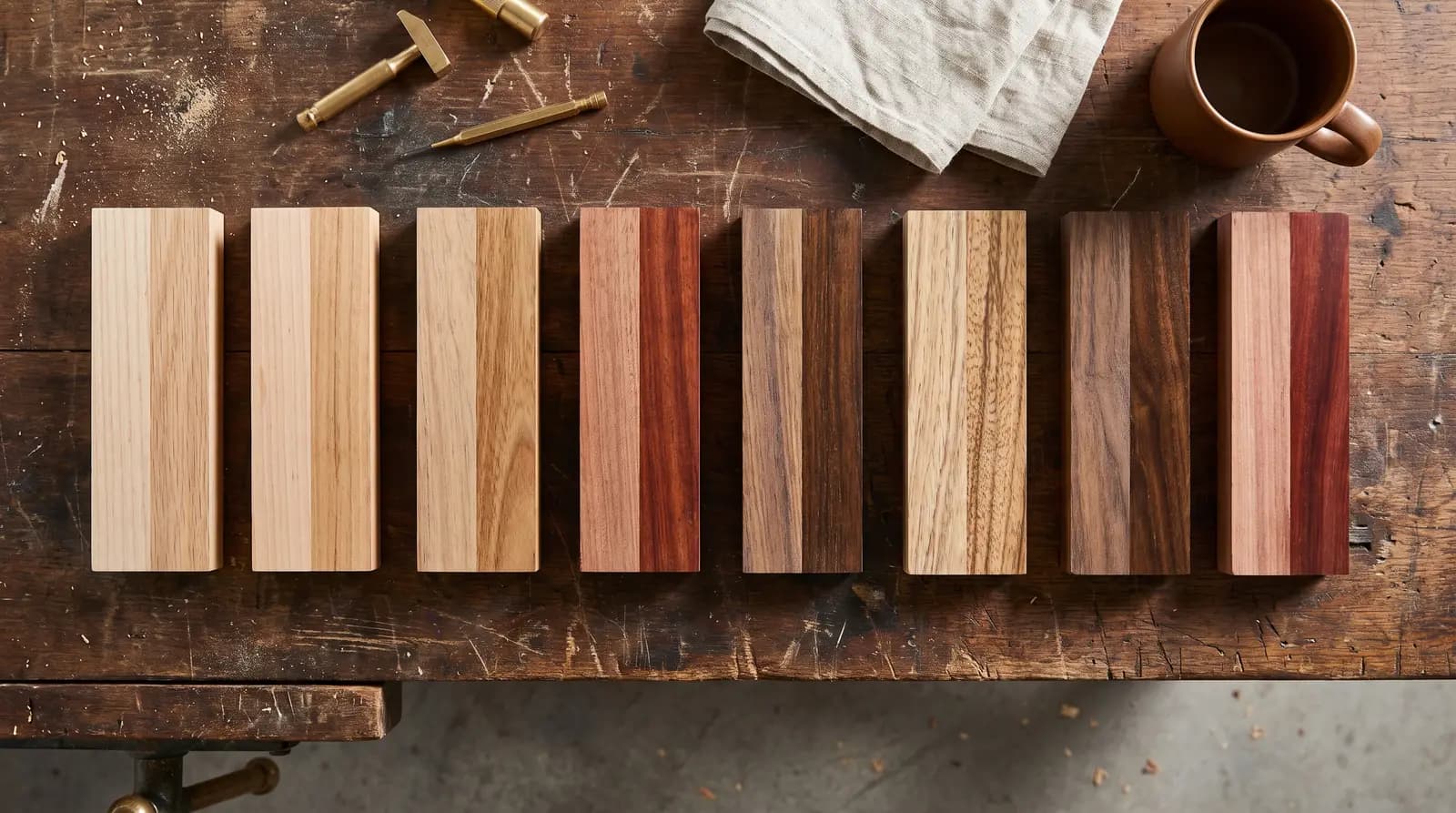
| Species | Cost vs Tas oak | Janka (kN) | Colour | Movement | Best use | | --- | --- | --- | --- | --- | --- | | Tasmanian oak / Victorian ash | baseline | 5.0 to 5.5 | Pale straw to light pink-brown | Moderate, very predictable | Large tops, frames, painted and stained work | | American oak | +15% to 25% | 5.5 to 6.0 | Pale biscuit, cool tone | Low to moderate, extremely consistent | Long runs of doors, matched sets | | Blackwood | +35% to 55% | 5.0 to 5.5 | Golden to mid red-brown, darkens fast | Low once dry, very stable | Feature pieces, buffets, chairs, doors | | Messmate | +10% to 25% | 6.0 to 7.0 | Warm honey with heavy gum vein | Moderate to high | Rustic tops, benches, character work | | Marri | +30% to 60% | 7.5 to 9.0 | Pink-cream with dark gum figure | Moderate, gum pockets need filling | Feature tops, resin-filled slabs | | Jarrah | +40% to 70% | 8.0 to 9.0 | Deep red-brown, ages to burgundy | Moderate, heavy and dense | Heavy tables, outdoor work, benches | | River red gum | +60% to 120% | 9.0 to 11.0 | Red through to near black | High, slow to dry, prone to checking | Thick slabs, live-edge pieces | | Recycled Baltic pine | +20% to 60% | 1.9 to 2.5 | Warm honey-orange, heavily aged | Low, already fully seasoned | Panelling, shelving, laminated tops |
There are 2 things that stand out and both matter. Recycled Baltic pine is very soft, roughly a quarter of the hardness of jarrah, which is why it dents under a dinner plate and is better used vertically than horizontally. And recycled stock costs more than new, not less, for reasons set out in recycled timber furniture in Adelaide.
What Adelaide's climate should do to your shortlist
Every other timber guide on the internet is written for a national audience and stops at colour. Here is the part that only matters in this city.
Timber holds moisture in equilibrium with the air around it. In a Melbourne living room that equilibrium sits around 10% to 12% moisture content most of the year. In an Adelaide house through a February heatwave, with refrigerated cooling running and the doors shut, indoor humidity can hold under 30% for weeks, and the timber drops toward 6%. A 1,000mm wide solid top will lose 6mm to 10mm of width across that swing, and then take most of it back in July.
That has 3 consequences for species selection:
- Prefer lower-movement species for wide flat panels. Blackwood and American oak are both quieter here than river red gum or messmate.
- Prefer quartersawn boards over flatsawn in any species. A flatsawn board moves roughly twice as much across its width as a quartersawn one cut from the same log, and it cups. This costs 10% to 20% more and it is the best-value upgrade on this page.
- Treat river red gum as a slab timber, not a panel timber. It is spectacular at 50mm thick with slotted fixings and difficult at 25mm across 900mm.
The Bureau of Meteorology publishes Adelaide's long-term humidity and temperature records at bom.gov.au, and they make the case better than any furniture page can: this is a genuinely dry city, and it has been for as long as anyone has been measuring.
North-facing glass
Adelaide extensions are glazed heavily to the north, which is correct for winter warmth and brutal for furniture. Direct sun will bleach an unprotected top unevenly within 1 summer, and it will do it in the shape of whatever was sitting on the table. Pale species show it least. Blackwood, jarrah and red gum show it most, because they have the furthest to fade.
This is a finish problem as much as a species problem, and it is the most common reason a 3-year-old table gets sent back for re-finishing.
Solid or veneer is an engineering decision
Veneer has a reputation problem in Australia because flat-pack furniture uses a printed foil and calls it a wood finish. Real timber veneer over a stable substrate is a different product and often the better one.
| Application | Correct choice | Why | | --- | --- | --- | | Dining tabletop | Solid | Will be sanded back and re-finished at least once | | Desk top | Solid | Same reason, plus edge wear | | Wardrobe or cabinet door over 600mm wide | Veneer | A wide solid panel cups and moves seasonally | | Bookcase or shelving carcase | Veneer or solid | Depends on span and load, not on appearance | | Bench seat or hall table | Solid | Load and wear | | Large panel run that must match | Veneer | Sequential leaves off 1 log give a match solid cannot |
A veneer leaf is about 0.6mm thick. One deep sanding goes through it, which is the whole argument against using it on a horizontal surface people eat off. On a vertical door that nobody sands, that limitation never arrives.
The dishonest version is a quote that says "oak" and means veneered board without saying so. Ask which, in writing, every time. It is the single question that explains most of the gap between 2 quotes for the same piece.
Hardness is not durability
Janka measures the force needed to press a steel ball halfway into the timber. It predicts dent resistance and nothing else. It does not predict scratch resistance, stain resistance, how the piece ages, or how easy it is to repair.
A Tasmanian oak table at 5.2 kN with a hardwax oil finish will dent more easily than a jarrah table at 8.5 kN. It will also be repairable at home in 20 minutes with a pad and a bottle of oil, where a dent through a catalysed lacquer means a full panel re-spray. Across 20 years the softer table usually looks better.
The 1 place Janka genuinely decides the outcome is recycled Baltic pine. At 1.9 to 2.5 kN it is 4 times softer than jarrah, and it will mark under normal dinner service. Used as panelling, shelving or a bedhead it is charming. Used as a family dining top it is a mistake that shows within a month.
Colour changes, and by how much
Colour is the property people choose on and the least permanent thing on the list. Every timber shifts under light and oxidation.
- Blackwood darkens 2 to 3 shades in the first 12 months and keeps warming slowly after that. Choose it 2 shades lighter than you want it.
- Tasmanian oak ambers gently, roughly 1 shade over several years.
- American oak is the most stable of the group and holds its cool tone.
- Jarrah and red gum deepen toward burgundy and then, under UV, fade back.
- Recycled Baltic pine is already fully oxidised and moves very little.
Always view a sample finished, not raw, and view it in the actual room. A blackwood sample under a workshop fluorescent and the same board under north light in an Adelaide extension look like 2 different species.
How species interacts with the finish
The species decision and the finish decision are not independent, and treating them as separate is where most disappointing results come from.
- Open-grained species (oak, jarrah, messmate) take a hardwax oil beautifully because the oil sits down in the grain and the texture stays readable. Under a high-build lacquer the grain fills and the surface goes flat and plastic looking, which defeats the point of choosing oak.
- Fine, even-grained species (blackwood, Tasmanian oak) take either. Blackwood under oil develops depth and chatoyance that lacquer suppresses.
- Pale species darken under oil by 1 to 2 shades immediately. A raw Tasmanian oak sample is not what your table will look like.
- Resinous and gum-veined species (marri, red gum, messmate) need the gum pockets stabilised before finishing, or they weep in summer heat.
Finish choice, and which one suits a family table, is covered in timber furniture finishes explained. The species reference data for Australian hardwoods is published by WoodSolutions.
Supply and lead time in Adelaide
Tasmanian oak and Victorian ash come through the eastern states in volume and are always available. American oak is imported and consistently stocked. Blackwood is available but variable: a maker matching a set of buffet doors may wait weeks for the right pack.
River red gum, marri and figured stock are bought when they appear rather than when they are needed, which is part of why they cost what they do. Reclaimed stock is the least predictable of all, and any quote using it should carry a longer lead time.
Across all species, December delivery slots in Adelaide workshops fill by about August. A species that needs sourcing pushes an 8 to 14 week job toward the top of its band.
How to choose, in 3 steps
- Start with the piece and the room, not the timber. A wide flat panel in a north-facing room narrows the field to stable, lower-movement species before colour is even discussed.
- Set the budget as a multiple. Decide whether you are at baseline, at baseline plus 25%, or at baseline plus 50%. That single number eliminates most of the table above and makes the rest of the conversation quick.
- View 3 finished samples in the room. Not raw offcuts, and not under workshop light. Bring them home and leave them on the floor for 2 days.
If you want the general species overview applied to a specific piece, the custom timber furniture page covers material selection across piece types, and custom dining tables covers the species and sizing decisions together.