Freestanding pieces
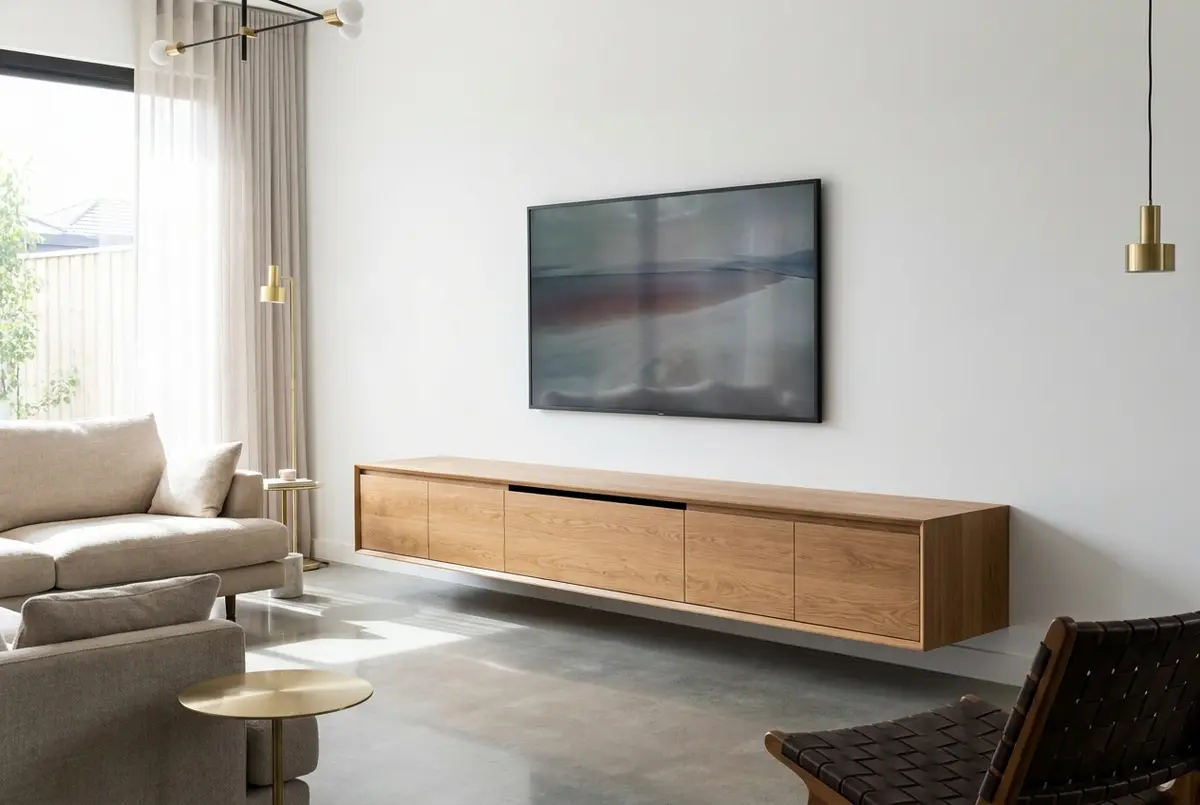
Custom entertainment units and TV cabinets in Adelaide
A custom entertainment unit in Adelaide costs $1,800 to $7,500, and most land between $2,600 and $4,200. Build time is 6 to 11 weeks. There are 2 specifications that decide whether it works: the unit has to be wider than the screen by 200mm to 300mm each side, and the AV bay has to breathe.
This is the piece where the engineering matters more than the timber. A beautiful unit that cooks a receiver, hides no cables and sits 200mm narrower than the TV has failed at everything except the photo. Below is the width maths, what a floating unit needs structurally in an Adelaide wall, the ventilation numbers, and why a veneered door is the right call on a wide front. Start with what custom furniture costs in Adelaide if you want the wider picture, or custom versus flat-pack if you are still deciding. A TV unit and a matching buffet are far cheaper quoted together than apart.
Proportion
The unit has to be wider than the screen
Screen width plus 200mm to 300mm each side. Below that, the TV overhangs visually and the whole wall looks top-heavy, which is the mistake retail units make because they are built to a shipping carton, not to a screen.
| TV size | Screen width | Minimum unit width | Width that looks right |
|---|---|---|---|
| 55 inch | 1,220mm | 1,620mm | 1,800 - 1,900mm |
| 65 inch | 1,440mm | 1,840mm | 2,000 - 2,200mm |
| 75 inch | 1,660mm | 2,060mm | 2,200 - 2,400mm |
| 85 inch | 1,880mm | 2,280mm | 2,400 - 2,700mm |
| 98 inch | 2,170mm | 2,570mm | 2,700 - 3,000mm |
Height is set by where your eyes are, not by what looks good in a showroom. Seated eye level on a normal sofa is 1,050mm to 1,150mm off the floor, and the centre of the screen wants to land at or just below that. If the TV stands on the unit, the carcase height should be 400mm to 500mm. If the screen is wall-mounted, the unit top can drop to 350mm to 450mm and the bracket does the rest.
Depth is the number people over-specify. Modern AV gear is 300mm to 380mm deep and a soundbar is under 150mm, so a 400mm to 450mm carcase is plenty, and 400mm plus an 80mm service void behind it is the correct answer. A 550mm deep unit is 150mm of floor you have given away for nothing, which matters in a narrow Adelaide villa lounge where the sofa is already tight against the opposite wall.
Buy the TV before the unit is drawn, or at least commit to the size. A unit designed around a 65 inch screen and delivered into a house that upgraded to 85 inch is a 2,000mm unit under a 1,880mm screen, which is exactly the proportion failure the width rule exists to prevent.
Structure
Floating looks better and costs more to do properly
A floating unit makes a small room read larger and makes vacuuming trivial. It also transfers every kilogram into the wall, which is where Adelaide's housing stock splits the answer in 2.
A stud wall, 1970s onward
Timber or steel studs at 450mm or 600mm centres. The fixing is a 90 x 35mm dressed hardwood cleat, or a 2-part cleat in 25mm ply, screwed with 100mm 14 gauge screws into at least 3 studs. Steel studs need a rated toggle system rather than a screw. Adds nothing to a quote beyond the cleat itself.
A pre-1940 villa or bungalow
Internal walls are usually solid brick, sometimes with battens and lath under the plaster. There are no studs to find, so the cleat is through-fixed with sleeve or chemical anchors into the brick and any batten cavity behind the plaster is packed solid so the cleat is not bridging a void. Adds $150 to $400 and half a day on site.
Plasterboard anchors are not an option here. They are rated on a straight pull-out test, and a 400mm deep cabinet does not apply a straight pull. It applies a moment: every kilogram sitting 400mm out from the wall levers the top fixings outward. A 2,000mm veneered floating unit weighs 45kg to 70kg empty and carries another 20kg to 25kg of gear, and somebody will eventually lean on it. Design for 150kg and fix into structure.
Floor-standing is not a compromise. It is the right answer on a rented wall, on any wall you are not confident about, and wherever the unit needs to move house. It also lets the unit carry more weight for less money, so a full-wall build with a heavy stone top or a run of drawers is usually floor-standing on a recessed plinth, which gives you most of the floating look for none of the structural argument.
Once the unit stops being a freestanding piece and becomes fixed cabinetry running the length of a wall, it is quoted as joinery rather than furniture, priced per linear metre, and the trade doing it is usually a cabinet maker. That is a different quote structure and it is worth knowing before you compare 2 prices that look far apart.
The detail that kills equipment
A closed cabinet cooks an amplifier
An AV receiver draws 100W to 300W in normal listening and turns nearly all of it into heat. Sealed into a 400mm deep cabinet behind a solid door, the air inside can sit 15 to 20 degrees above room temperature. On a 40 degree Adelaide day in a living room that is already at 26, that is an amplifier running near its thermal cut-out, and the failure it causes is gradual: capacitors age faster, the unit starts dropping into protection mode, and nobody connects it to the cabinet.
The passive fix is 3 things and it costs nothing at build time. A full-height open rear reveal of at least 50mm, and 80mm to 100mm is better because it doubles as the cable void. A 25mm to 30mm clear gap above each component, not just above the top one. And an air path in at the bottom: a vented plinth, a 30mm gap under the doors, or a perforated toe kick. Heat rises, so the cabinet needs a low inlet and a high outlet or nothing moves.
The active fix is a thermostatic fan kit fitted into the carcase at build, at $180 to $400. Worth it where the gear has to sit behind solid doors for aesthetic reasons, or where a projector or a games console shares the bay. Specify it at drawing stage: retrofitting means cutting a finished cabinet.
If the doors must be closed, fabric-backed or perforated fronts on the AV bay solve the airflow and the infrared remote problem at the same time. Solid timber doors block both.
The cable spec to ask for
- 1.A full-height rear service void, 80mm to 100mm deep.
- 2.A removable rear panel, so the void is reachable after install.
- 3.60mm grommets or brush plates through every shelf the cables cross.
- 4.A 4 or 6 outlet board mounted inside the void, not trailing on the floor.
- 5.A 50mm in-wall conduit between a wall-mounted screen and the unit.
- 6.Velcro ties, not zip ties, so a component can be swapped in 5 minutes.
Fronts and hardware
Why a veneered door is the better engineering call
This is the one place on the site where we argue against solid timber, and the reason is arithmetic rather than taste.
A wide entertainment unit puts 3 or 4 doors in a row with 3mm reveals between them, all of it read against a straight horizontal line at eye level. Nothing shows movement more clearly. A 900mm wide solid timber door moves 6mm to 9mm across its width between a humid Adelaide July and a February living room held under 30% relative humidity by ducted cooling. That is 2 to 3 times the reveal. In winter the doors bind against each other, in summer the gaps open unevenly, and no amount of hinge adjustment fixes a door that changes size twice a year.
A veneered door on 18mm ply or MDF moves under 1mm across the same range, and it takes the same timber, the same grain and the same finish. On a wide front it is not the cheaper option pretending to be the good one: it is the correct one. Where you do want solid, a framed-and-panelled door is the middle path, because the frame is narrow enough to move very little and the panel floats free in its groove.
Keep the solid timber where it earns its place: the carcase top if it is a floor unit, the plinth, the drawer fronts if they are under 500mm wide, and the visible edges. That gives you the depth and repairability of solid where hands touch it, and stability where the geometry is unforgiving.
Push-to-open or handles
Push-to-open catches need a consistent 2.5mm to 3mm gap all round and a door that stays flat, which is another argument for veneer. They give you the clean handleless front most people want under a screen. The trade-offs are real though: fingerprints show on an oiled or matt front exactly where you push, and a door held closed by a spring catch is easier for a small child to open than a soft-close hinge with a handle. Handles or a routed finger pull along the top edge are more forgiving in a family room, and the finger pull keeps the front line unbroken.
Whichever you pick, ask for soft-close on every hinge and runner as standard, and ask for full-extension runners rated to 40kg on any drawer holding games or vinyl. Those 2 details are where a $2,600 unit and a $4,200 unit quietly differ. More on how the trades differ and who to call is in our shelving and bookcase guide, which covers the same span and load questions across a wall.
FAQ
Custom entertainment units in Adelaide: common questions
How much does a custom entertainment unit cost in Adelaide?
Between $1,800 and $7,500, with most landing between $2,600 and $4,200. A 1,800mm floor-standing unit with 2 doors and an open AV bay starts the range. A 2,400mm floating unit with drawers sits in the middle. A full-wall build with overheads and shelving flanking the screen runs to the top of it and is quoted as joinery.
How wide should a TV unit be for a 65 inch TV?
A 65 inch screen is about 1,440mm wide, so the minimum unit width is 1,840mm and 2,000mm to 2,200mm looks better. The rule is screen width plus 200mm to 300mm each side. A unit narrower than the screen makes the TV look like it is falling off the ends, and it is the single most common proportion mistake on this piece.
Do AV components need ventilation in a cabinet?
Yes, and a sealed cabinet will shorten an amplifier's life. A receiver draws 100W to 300W in normal use and dumps nearly all of it as heat, which can push a closed 400mm deep cabinet 15 to 20 degrees above room temperature. The passive fix is a full-height open rear reveal of at least 50mm, a 25mm to 30mm gap above each component, and a vented plinth.
What does a floating entertainment unit need to hold it up?
A hardwood or thick ply cleat screwed into at least 3 studs with 100mm 14 gauge screws, never plasterboard anchors. A 2,000mm veneered floating unit weighs 45kg to 70kg before you load it, and a 400mm deep cabinet applies leverage that anchor ratings do not cover. In a solid brick Adelaide wall it is masonry or chemical anchors instead, which adds $150 to $400.
How do you hide the cables in a custom TV unit?
A full-height rear service void 80mm to 100mm deep behind the carcase, a removable rear panel so you can reach it later, and 60mm grommets or brush plates through each shelf. For a wall-mounted screen, add a 50mm conduit run in the wall between the screen bracket and the unit. In a stud wall that is $150 to $300, and in solid brick it costs considerably more.
Should the doors be solid timber or veneered?
Veneered, on almost any unit over 1,800mm. A 900mm wide solid timber door moves 6mm to 9mm across its width between an Adelaide winter and a February under ducted cooling. With 3mm reveals between doors, that is the difference between a flush front and doors that jam or gap. A veneered door on 18mm ply or MDF moves under 1mm.
Keep reading
You might also find this useful
- Custom shelving and bookcasesShelf spans that will not sag, and the alcove work that usually flanks an entertainment unit on the same wall.Read it
- Cabinet makers in AdelaideCarcase and sheet-goods work is a different trade to furniture making, and a wide TV unit sits squarely in it.Read it
- Choosing timber and veneerWhich species suit Adelaide's dry climate, and how a veneer differs from solid once it is on your wall.Read it
Start here
Get your entertainment unit priced by Adelaide makers
Send us the wall width, your screen size, what gear has to fit and whether you want it floating. We pass it to a local maker who does this work, and they quote you directly.
- Free to use. The maker may pay us a fee, you never do.
- Check the maker's ABN, insurance and completed Adelaide work before you commit.
- Adelaide metro only, so you are not sent to an interstate workshop.