Freestanding pieces
Custom dining tables made in Adelaide
A custom dining table in Adelaide costs $2,800 to $9,000, and most land between $3,500 and $5,500. Build time is 8 to 14 weeks from deposit. The 2 decisions that decide both numbers are the timber species and how the top is built to survive an Adelaide summer.
Everything below is the detail you need to brief a maker properly: real sizing against your room, what each timber costs and does, and the construction question that separates a table that lasts from one that opens up at the glue line. If you want the wider picture first, read what custom furniture costs in Adelaide, then how to measure your room. Pairing a table with a matching buffet is worth raising at quote stage, because it is far cheaper to build both from one timber pack.
Sizing
What size table your room actually takes
It comes down to 2 numbers. Allow 600mm of table edge per person, and allow 900mm of clearance between the table edge and the nearest wall or furniture so a chair can be pushed back and walked around.
| Seats | Table length | Table width | Minimum room length |
|---|---|---|---|
| 4 | 1,200 - 1,400mm | 800 - 900mm | 3,000mm |
| 6 | 1,700 - 1,900mm | 900 - 1,000mm | 3,500mm |
| 8 | 2,100 - 2,400mm | 950 - 1,050mm | 3,900mm |
| 10 | 2,700 - 3,000mm | 1,000 - 1,100mm | 4,500mm |
| 12 | 3,200 - 3,600mm | 1,050 - 1,200mm | 5,100mm |
The 900mm clearance figure is the one that catches people out. Most size guides quote 600mm, which is enough to sit down but not enough to stand up and walk behind someone who is seated. In an open-plan Adelaide extension, where the dining zone usually sits on a circulation path between the kitchen and the back door, 900mm is the number that makes the room work.
Width matters more than length for how a table feels. Below 900mm, 2 place settings opposite each other leave no middle for serving dishes. Above 1,100mm, passing anything across becomes a reach. 950mm to 1,050mm is the band nearly every good table sits in, and a maker who suggests otherwise should have a specific reason.
Round tables
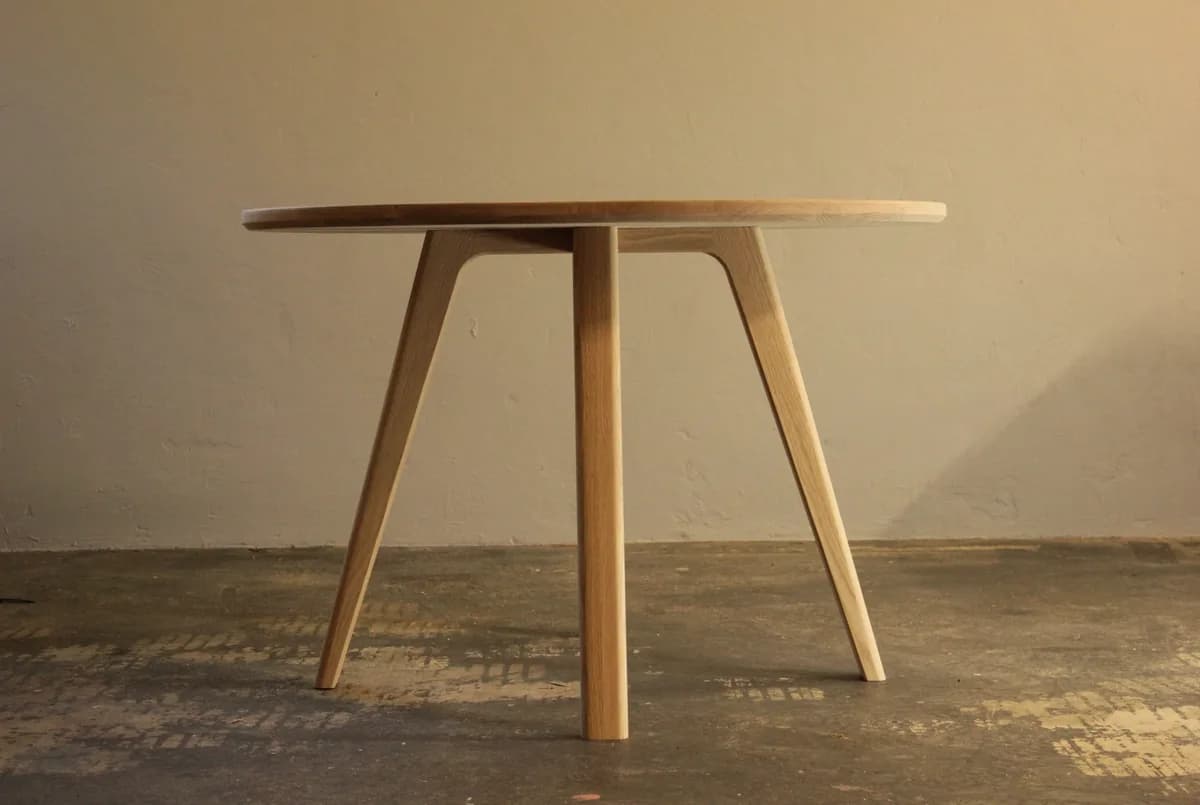
Round is genuinely better in a square room, in a room under 3,500mm on its short side, or where the table has to sit near a doorway. A 1,200mm round seats 4, 1,400mm seats 6, and 1,600mm seats 6 to 8 comfortably. Expect to pay 10% to 20% more than a rectangle of equal capacity, because cutting a circle out of square boards wastes timber, and expect a pedestal base rather than legs so nobody straddles a leg.
Timber
What each species costs and how it behaves
Prices are relative to Tasmanian oak on the same table. This is the decision that moves a quote most, and the one most people leave until last.
Tasmanian oak / Victorian ash
BaselinePale, straight-grained and stable. The workhorse. Takes a stain well if you want it darker, and the easiest species to match if a leaf is added later.
American oak
+15% to 25%Very consistent board to board, warm mid-tone, extremely hard-wearing. The safe choice when the table has to match existing joinery.
Blackwood
+35% to 55%Warm golden-brown with genuine figure, and the species most Adelaide makers push for a feature table. Darkens noticeably in its first year, which surprises people. See our comparison with Tasmanian oak.
River red gum
+60% to 120%Deep red, dramatic, often live-edge. High waste factor and slow to dry, which is where the cost sits. Best on a slab top rather than a glued panel.
Recycled Baltic pine or messmate
+20% to 60%Softer than the hardwoods above, so it marks. Character comes from the nail holes and old saw marks, which is either the point or a dealbreaker.
Full detail on how each behaves in a South Australian house is in the timber guide, and the head-to-head most Adelaide buyers end up having is blackwood versus Tasmanian oak.
The question that separates makers
Ask how the top is allowed to move
Timber moves across its width with humidity, all its life. A 1,000mm wide solid top can change by 6mm to 10mm between a humid July and a dry February. Adelaide makes this worse than anywhere else on the mainland: it is the driest capital, and a house running ducted or evaporative cooling through summer can sit under 30% relative humidity indoors for weeks.
A top that is not free to move will crack somewhere. Either the glue lines open, or the top splits at the fixing points, or a glued breadboard end tears itself off. This is the most common avoidable failure on custom tables in this city, and it shows up in the first or second summer.
So ask one question: how is the top attached to the base, and how does it move? Good answers involve buttons, z-clips, elongated slotted screw holes, or a breadboard end that is pinned through a slot and glued only at the centre. A bad answer is screws driven straight through a fixed rail into the top. If the maker cannot answer it quickly and specifically, that tells you more than any portfolio photo.
The second question worth asking is whether the underside gets finished too. It should. Finishing only the top means the 2 faces take on and give up moisture at different rates, and the top cups. It costs the maker an extra hour and it is the difference between a flat table and a bowed one.
We have written this up in full in why solid timber tables split in Adelaide homes.
Ask these 5 at quote stage
- 1.Is the top solid or veneered, and how thick?
- 2.How is the top fixed to the base, and how does it move?
- 3.Is the underside finished as well as the top?
- 4.What finish, how many coats, and can it be spot repaired?
- 5.What does the warranty say about movement and cracking?
Cost
Where the money goes on a $4,500 table
Working backwards through a quote is the fastest way to tell an honest one from a thin one.
$900 - $1,400
Timber, bought rough-sawn, with 30% to 40% lost to machining and defect
$250 - $500
Finish, abrasives, glue, hardware and consumables
$2,200 - $2,800
35 to 50 hours of labour across milling, joinery, assembly, sanding and 3 to 5 finish coats
The rest
Workshop overhead, insurance, delivery and margin
When a quote comes in well under the band, the saving has come out of the timber, the joinery or the finishing hours. Those are all legitimate ways to build to a budget. They are only a problem when nobody tells you that is what happened, which is why the 5 questions above are worth asking of every quote you get.
FAQ
Custom dining tables in Adelaide: common questions
How much is a custom dining table in Adelaide?
Between $2,800 and $9,000, with most landing between $3,500 and $5,500. Timber species moves that number far more than size does: going from 1,800mm to 2,400mm typically adds 15% to 20%, while going from Tasmanian oak to figured blackwood can add 60%.
What size table do I need for 8 people?
Allow 600mm of table edge per person. An 8 seater therefore wants 2,100mm to 2,400mm long by 950mm to 1,050mm wide, seating 3 down each side and 1 at each end. The room needs to be at least 3,900mm long to take a 2,400mm table with usable clearance behind the chairs.
Can I get a custom round dining table?
Yes, and round is the right call in a square room or where circulation is tight. A 1,200mm round comfortably seats 4, 1,400mm seats 6, and 1,600mm seats 6 to 8. Round tops cost 10% to 20% more than a rectangle of the same seating capacity because of the waste when cutting a circle out of square boards, and they almost always need a pedestal base so legs do not land where knees do.
Are extension dining tables worth it?
They are worth it if you genuinely go from 6 to 10 a few times a year, and not worth it if you are hedging. A butterfly or draw-leaf extension adds $600 to $1,800 because it is a second piece of precision engineering inside the first, and it constrains the base design. Most people who order an extension because they might need it end up leaving it extended permanently, in which case they should have ordered the longer table.
How long does a custom dining table take?
8 to 14 weeks from deposit for most Adelaide workshops. That is not build time, it is queue plus build. December delivery slots are typically full by August, so a table for Christmas needs ordering in winter.
What is a breadboard end and do I need one?
It is a strip of timber running across each end of the top, grain running the opposite way, that keeps a wide top flat. It must be pinned and slotted rather than glued along its length, so the top can shrink and swell underneath it. In Adelaide's dry summers that detail matters: a glued breadboard end on a solid top will crack, usually in the first February.
Keep reading
You might also find this useful
- How to measure for a custom dining tableThe clearance rules that decide what size your room actually takes, with the 900mm figure most guides get wrong.Read it
- What a custom dining table costs in AdelaideThe full cost breakdown by size, timber and base type, and the 4 changes that add the most.Read it
- Custom buffets and sideboardsBuilding a matching buffet from the same timber pack is much cheaper than commissioning it separately later.Read it
Start here
Get your table priced by Adelaide makers
Tell us the size, the room and roughly what you want to spend. We pass it to a local maker who builds tables, and they quote you directly.
- Free to use. The maker may pay us a fee, you never do.
- Check the maker's ABN, insurance and completed Adelaide work before you commit.
- Adelaide metro only, so you are not sent to an interstate workshop.