Built-in and fitted
Custom shelving and bookcases in Adelaide
Custom shelving in Adelaide starts at $1,400 for a single fitted alcove unit and runs to $9,000 for a full wall, over 5 to 10 weeks. One number decides the whole design: shelf span. Under a real book load, 18mm melamine bows past 700mm, 32mm solid hardwood holds 1,000mm, and past that you need a centre divider rather than a thicker board.
A bookcase is the one piece of furniture that is routinely designed to fail. Books are heavy, spans get stretched to suit an alcove, and the sag shows up 12 months after the money was spent. Below is the span and depth data to design against, plus how a fitted unit gets scribed into an older Adelaide room. If the job is part of a wider fitout it belongs under custom joinery, the same scribing problem drives built-in wardrobes, and the wider price picture is in what custom furniture costs in Adelaide.
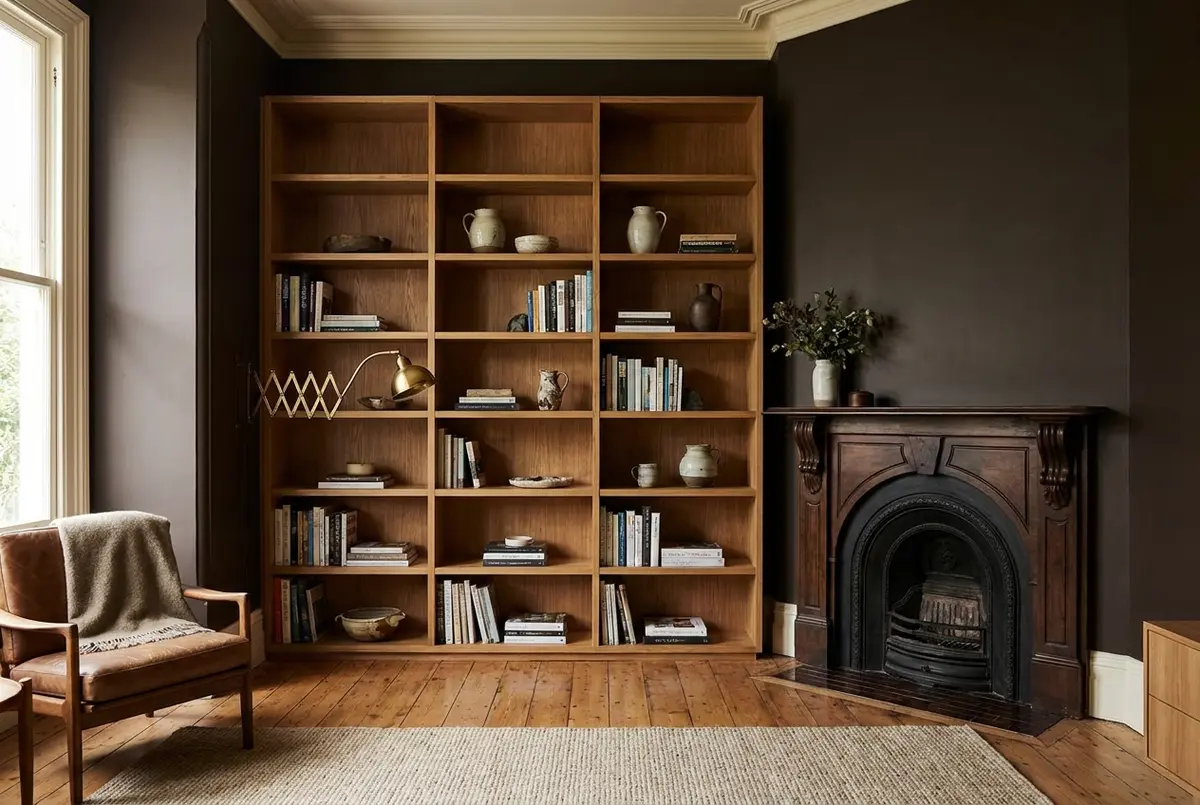
Span and sag
How far a shelf goes before it bows
Figures are for a shelf carrying a full run of books along its whole length, which is the load that matters. A shelf holding 3 vases will span further and tells you nothing.
| Shelf build | Safe clear span | What to know |
|---|---|---|
| 16mm to 18mm melamine board | 600 - 700mm | The flat-pack default. Bows visibly within a year past 700mm and never recovers, because the sag sets into the board. |
| 18mm hardwood plywood | 750 - 850mm | Stiffer than melamine for the same thickness. Needs a solid edge strip to hide the plies, which also adds a little stiffness. |
| 25mm solid hardwood | 850 - 950mm | The point where a shelf starts to look like furniture rather than storage. Tasmanian oak, blackwood or American oak all behave similarly here. |
| 32mm solid hardwood | 1,000mm | A metre clear, fully loaded, with no visible deflection. The upper limit for a plain shelf and a noticeably heavier piece to build. |
| 18mm board with a 50mm front rail | 1,000 - 1,100mm | The cheapest span you can buy. A rail glued to the front edge acts as a beam and does more for stiffness than doubling the shelf thickness. |
| Torsion box, 40mm or more finished | 1,200 - 1,400mm | A hollow shelf with an internal frame. Long spans that look thin, at genuine cost. Reserve it for a feature run. |
That whole table comes down to 2 pieces of physics. Deflection rises with the cube of the span, so stretching a shelf from 800mm to 1,000mm does not add 25% of sag, it adds around 95%. Stiffness also rises with the cube of the thickness, which is why going from 18mm to 32mm roughly quintuples what a shelf will carry. The corollary is the useful one: depth in the direction of the load beats material every time, and that is why a 50mm rail glued along the front edge of an 18mm shelf outperforms a solid 32mm shelf while costing a fraction as much.
Load matters as much as span, and people underestimate it badly. A linear metre of paperbacks weighs 15kg to 20kg. A metre of hardbacks weighs 25kg to 30kg. A metre of 12 inch vinyl weighs 50kg to 70kg, which is roughly 3 times the book load and enough to bend a shelf that would have been fine forever holding novels. If records, textbooks or a full run of lever-arch folders are going on it, that is the first sentence of the brief, not a detail mentioned at delivery.
Past 1,000mm the correct answer is not a thicker board. It is a vertical divider, which halves the span and adds structure to the carcase at the same time, or a bulkhead above a wide opening that lets the shelf sit in 2 bays. A maker who offers to go to 1,400mm in 25mm solid because you asked for an uninterrupted run is telling you what you want to hear.
Depth
Build to the deepest thing you own
| What goes on it | Shelf depth |
|---|---|
| Display objects and framed photos | 180 - 220mm |
| Paperbacks | 200mm |
| Standard hardbacks | 250mm |
| Large art and coffee-table books | 320 - 350mm |
| 12 inch vinyl records | 320mm |
| A4 lever-arch folders | 320mm |
Build to the deepest item and use the surplus deliberately: stand smaller books flush to the front edge and the run reads as one line rather than a ragged one. A 200mm shelf holding a 300mm art book is the most common regret in fitted shelving, and it cannot be fixed afterwards.
Adjustable or fixed
Use both, in a deliberate pattern
A fixed shelf is housed into a groove cut across each side panel, so it is structural. It ties the 2 sides together, stops the carcase racking under load, and carries the spans in the table above without qualification.
An adjustable shelf sits on 4 pins. Those are point supports that cannot resist rotation, so the same board carries less: derate the span by roughly 15%. A 32mm solid shelf rated at 1,000mm fixed should be treated as 850mm on pins.
The build that works is a hybrid. A fixed shelf every third or fourth position gives the unit its structure and its longest spans, and adjustable shelves in between let you re-space for paperbacks, folders or a record collection later. It costs almost nothing extra at build time and it is the difference between a bookcase that adapts and one that does not.
Lighting, if you want it
Run the LED strip in a rebate at the front underside of the shelf above, not at the back, so the light falls down the spines rather than up the wall. Choose 2700K to 3000K in a living room: anything cooler makes timber look grey. Budget $80 to $200 per shelf run for the strip and channel, plus an electrician for a switched point, and agree where the driver lives and how you get at it before the unit is built rather than after.
Fitting an older room
Alcoves, chimney breasts and 230mm skirtings
The classic Adelaide brief is a pair of units either side of a fireplace. It is also the brief where a flat-pack solution always looks wrong, and for a measurable reason.
The alcoves beside a villa chimney breast are typically 800mm to 1,200mm wide and 300mm to 400mm deep, and they are never a matched pair. The 2 openings in the same room commonly differ from each other by 20mm to 40mm in width, and each one is often 10mm to 20mm narrower at the top than at the bottom because the wall leans. The 2 units therefore cannot be built to the same cut list, which is why an alcove pair costs more than twice a single unit and why the site measure has to happen before anything is drawn.
Skirtings are the next obstacle. Adelaide villas and bungalows carry deep moulded skirtings, commonly 150mm to 230mm tall, and a cabinet cannot simply sit against one. There are 3 honest options. Scribe the carcase around the moulded profile, which is exact, slow and the most expensive. Cut the skirting out of the opening, which is fast and irreversible, and a poor idea in a house where the joinery is part of the value. Or set the unit forward on a plinth that clears the skirting entirely, which costs the least, takes 20mm to 30mm of floor and almost always looks the most deliberate.
Picture rails sit at 2,100mm to 2,400mm and force the same decision higher up. Stopping the unit under the rail is the simplest and keeps the room reading as original. Running past it means either scribing around the moulding at every intersection or removing that section of rail, and once a rail is cut the room has lost a feature it will not get back cheaply.
One material note specific to this city. A fitted unit is restrained by the walls, so a wide solid timber shelf or a solid panel back cannot move freely, and Adelaide interiors sit under 30% relative humidity for weeks in February when the cooling runs. Fitted shelving is therefore built from veneered or laminated stable sheet stock with solid timber used for edges, face frames and rails. That is not cost-cutting, it is the correct engineering for a piece that is not allowed to move. The species question is covered in the timber guide.
FAQ
Custom shelving and bookcases in Adelaide: common questions
How far can a bookshelf span before it sags?
Under a full load of books, 16mm to 18mm melamine bows visibly past about 700mm, 18mm hardwood plywood holds 750mm to 850mm, and 32mm solid hardwood holds about 1,000mm. Adding a 50mm front rail to an 18mm shelf lifts it to 1,000mm or more. Past that, the answer is a centre divider rather than a thicker shelf.
How much does custom shelving cost in Adelaide?
From $1,400 for a single fitted alcove unit. A matched pair either side of a chimney breast runs $2,800 to $4,500, and a full wall of floor-to-ceiling shelving 3 metres wide runs $3,500 to $9,000 depending on material, whether the lower section has doors, and how much scribing the room demands. Build time is 5 to 10 weeks.
How deep should bookshelves be?
Paperbacks need 200mm, standard hardbacks 250mm, and large-format art books, A4 lever-arch folders and 12 inch vinyl records all need 320mm. Build to the deepest thing you own, then use the extra depth deliberately by standing smaller books forward and flush. A 200mm shelf holding a 300mm book is the most common regret in fitted shelving.
Are adjustable shelves better than fixed?
Fixed shelves are stronger and hold the whole unit square, because they are housed into the sides and stop the carcase racking. Adjustable shelves sit on 4 pins, which are point supports, so derate their safe span by roughly 15%. The right build uses both: a fixed shelf every third or fourth position for structure, with adjustable shelves between them.
Can shelving be fitted around skirtings and picture rails?
Yes, and in an Adelaide villa it has to be. Deep moulded skirtings of 150mm to 230mm and picture rails at 2,100mm to 2,400mm both sit in the way. The 3 options are scribing the unit around the profile, cutting the moulding out, or setting the unit forward on a plinth that clears it. The plinth is cheapest and usually looks best.
Do you cover garage or warehouse racking?
No. Industrial racking, warehouse pallet racking and garage storage systems are engineered, load-rated products from a different supply chain, and they are sold and installed by specialists in that field. This page and the enquiries we pass on cover fitted joinery and freestanding furniture for the inside of a home: alcove units, bookcases, display shelving and library walls.
Keep reading
You might also find this useful
- Custom entertainment unitsShelving with a screen in it, where ventilation and cable routing change the design entirely.Read it
- Cabinet makers in AdelaideThe trade that builds fitted shelving, how they quote sheet-goods work, and what to check before you commission one.Read it
- How commissioning actually worksMeasure, drawings, deposit, build, install. What you need ready at each stage of a fitted job.Read it
Start here
Get your shelving priced by Adelaide makers
Tell us the opening width, the depth you need and what is going on the shelves. We pass it to a local maker who builds fitted work, and they measure and quote you directly.
- Free to use. The maker may pay us a fee, you never do.
- Check the maker's ABN, insurance and completed Adelaide work before you commit.
- Adelaide metro only, so you are not sent to an interstate workshop.