Freestanding pieces
Custom buffets and sideboards made in Adelaide
A custom buffet or sideboard in Adelaide costs $2,400 to $7,500, and most land between $3,200 and $4,800. Build time is 8 to 13 weeks from deposit. Depth and door layout decide both the price and whether the dining room still works: 450mm to 500mm deep is the sweet spot, and every drawer you add is a second box built inside the first.
Buffet cabinets are the dining-room piece people get wrong on dimensions rather than on taste. Below is the sizing against a real room, what each layout costs, and why a wide solid door panel is a worse idea here than a veneered one. Commissioning it alongside a custom dining table from one timber pack is materially cheaper than ordering it later. If the timber choice is still open, the head-to-head worth reading is blackwood versus Tasmanian oak, and the shortest route to an accurate quote is knowing what a maker needs from you.
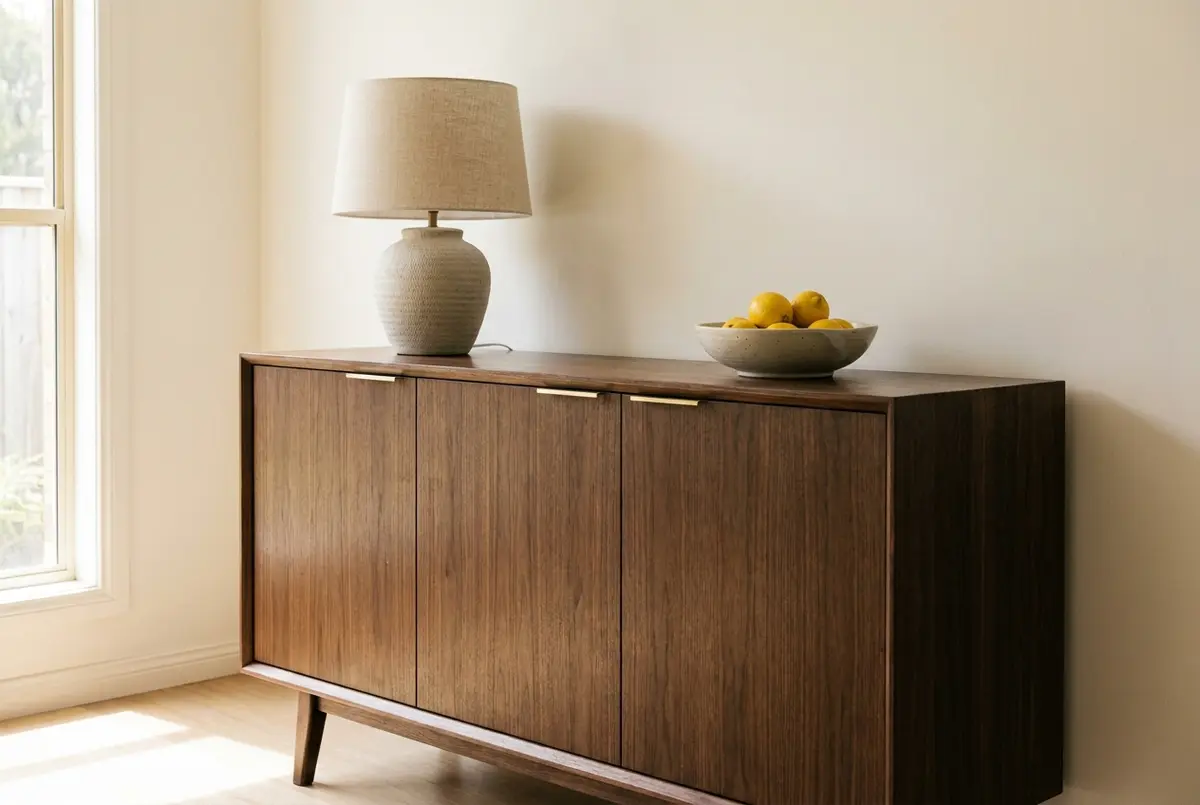
Dimensions
Depth is decided by the walkway, not by the storage
A buffet fails on dimensions long before it fails on timber. Fix depth, height and width first, and only then talk about species and handles.
| Buffet depth | Walkway left | Verdict |
|---|---|---|
| 400mm | 900mm | Comfortable. The right call in a narrow room, but it will not take a large serving platter flat. |
| 450mm | 850mm | The standard choice. Takes a dinner plate flat with room behind it and still walks past cleanly. |
| 500mm | 800mm | The practical maximum in a dining room. Genuinely more useful storage, and 800mm still works. |
| 600mm | 700mm | A squeeze. One chair pushed back closes the gap entirely and nobody gets past the table. |
| 700mm | 600mm | Kitchen carcase depth. Not viable against a dining table unless the room is much wider. |
The maths behind that table is simple and worth doing on your own room. A 3,600mm wide dining room with a 1,000mm table centred in it leaves 1,300mm on each side. Subtract the buffet depth and what remains is the walkway. Protect 800mm of it. Below that, 2 people cannot pass each other, and a dining chair pushed back into the gap closes it completely.
Height is the second number and the one that gets copied wrongly from a showroom. Sit the top at 800mm to 900mm. That is 40mm to 150mm above the dining table, which is enough for the 2 pieces to read as separate objects and enough to serve from while standing. Anything above 950mm behaves like a kitchen bench in a room that does not want one, and in a pre-1940 villa it will foul a window sill or run into the picture rail.
Width should be 65% to 80% of the table length. An 1,800mm table takes a 1,200mm to 1,450mm buffet, a 2,400mm table takes 1,600mm to 1,900mm. Most buffet furniture built in Adelaide homes lands between 1,500mm and 1,900mm long. Going longer than the table looks wrong from every seat, and going shorter than 1,200mm rarely earns the cost of a custom build.
Layout
Doors, drawers, and where the money actually goes
Prices are for a 1,600mm to 1,900mm cabinet in Tasmanian oak. Change the timber and the whole column moves, but the gaps between the layouts hold.
| Layout | Typical cost | Vs all doors | What you get |
|---|---|---|---|
| 4 doors, adjustable shelf in each bay | $2,400 - $3,200 | Baseline | Cheapest per litre of storage. Everything behind a door ends up stacked, so it suits crockery and platters more than cutlery. |
| 2 doors plus a 3-drawer bank | $2,800 - $3,800 | +12% to 18% | The layout most people should order. Drawers take the daily items, the door bay takes the tall and awkward ones. |
| Doors with internal drawers behind them | $3,000 - $4,000 | +18% to 25% | A clean, calm front elevation with drawer function behind it. You open 2 things instead of 1 to reach the cutlery. |
| 6 drawers, no doors | $3,100 - $4,300 | +25% to 35% | Best storage discipline of any layout and the most expensive to build. Wasted if you own tall things. |
| Any of the above, grain-matched fronts | Add 10% to 20% | On top | Buys continuity of figure across the closed front. Only worth it in a timber with figure worth following. |
The reason drawers cost what they do is structural, not a markup. A door is a single panel, a pair of hinges and an hour of fitting. A drawer is a box inside a box: 4 sides, a bottom, a separate applied front, a pair of runners at $45 to $130 for cabinet-grade full-extension soft-close hardware, and the fitting time to get every front sitting on the same 2mm reveal across the elevation. Multiply that by 6 and you are building a second cabinet inside the first.
That is why a mixed layout is usually the right order. Put the drawers where you reach daily, which is cutlery, placemats, table linen and candles, and leave 1 door bay for the tall and awkward things that drawers handle badly: decanters, vases, a stand mixer, board games. Ask for the layout options priced separately on the quote. Any maker who builds buffet cabinets regularly can do that in 10 minutes, and it shows you exactly what each drawer costs.
Fronts
Why a wide solid door is the wrong engineering here
A dining table can be a solid slab because it is fixed at 4 points and free to move everywhere else. A door cannot. It has to stay the same size, because it sits inside an opening with a 2mm gap around it and a pair of hinges holding it to a fixed edge.
Timber moves across its width for its whole life. A 450mm wide solid panel will change by 3mm to 5mm between a humid July and a February in a house running ducted or evaporative cooling, which in the driest mainland capital can sit under 30% relative humidity indoors for weeks. On a door, that is the difference between shutting properly and either binding on the frame or opening a shadow line you can see from the table.
There are 2 correct answers, and neither is a downgrade. A framed and panelled door lets a solid centre panel float in a groove while the frame holds the overall dimension. A veneered panel on a stable ply or MDF core does not move measurably at all. The second is the better engineering for a wide flat front, and it is the only way to get a genuine grain match running across 4 closed doors, because veneer is sliced in sequence from a single flitch.
Grain matching costs 10% to 20% because the maker buys more material than the cut list needs and then has to keep the sequence intact through machining, edging and finishing. It is worth paying for in blackwood or a figured board and close to pointless in a plain, straight-grained timber. Read the timber guide before you commit to a species.
One last detail specific to this city. Adelaide extensions are glazed heavily to the north, and a buffet on the wall opposite that glass will lighten across the exposed doors within a single summer while the shadowed end stays put. A light-fast finish slows it. Moving the bowl or the runner that sits on top of it every few months stops it becoming a hard line.
Base detail: plinth or legs
A plinth is a recessed box under the carcase, typically 100mm to 140mm tall with the face set back 50mm to 60mm so you can stand close without kicking it. It gives the piece weight, it hides an out-of-level floor because it can be scribed to the boards, and nothing gets under it.
Legs do the opposite. The floor reads as continuous, the room feels bigger, and you have to clean under it. If a robot vacuum lives in the house, insist on 120mm of clear height or it will wedge itself under the cabinet.
An older Adelaide floor can be out by 10mm to 20mm across 1,800mm. A plinth absorbs that with a scribe. Legs need adjustable feet, and they must be specified, not assumed.
Before you enquire
The 5 things to settle before anyone quotes
Every one of these changes the price. Handing them over at the start is the difference between a quote and an estimate.
- 1.The clear wall length available, and where the power point and any floor vent sit. A buffet that covers a power point is a buffet you will regret.
- 2.The narrowest point on the delivery path. A 1,900mm cabinet weighs 70kg to 100kg and will not turn a tight villa hallway or clear an 820mm door on the diagonal. Measure it before you order, not after.
- 3.Depth, decided from the walkway maths above rather than from what you want to store.
- 4.What actually goes inside: plates and platters, cutlery, table linen, glassware, board games, a printer. This decides the drawer-to-door split, and the split decides 25% to 35% of the price.
- 5.Whether the fronts have to match an existing table, floor or joinery. Matching an existing finish is a legitimate extra cost and it needs to be on the table at quote stage, not discovered at delivery.
FAQ
Custom buffets and sideboards in Adelaide: common questions
How much does a custom buffet cost in Adelaide?
Between $2,400 and $7,500, with most landing between $3,200 and $4,800 for a 1,600mm to 1,900mm piece. Layout moves that number more than length does. An all-door cabinet sits at the bottom of the band, the same cabinet built with 6 drawers sits 25% to 35% higher, and grain-matched fronts add another 10% to 20% on top of whichever layout you pick.
How deep should a buffet or sideboard be?
Between 450mm and 500mm. That depth takes a dinner plate flat, a stack of serving bowls and most table linen, and it still leaves a walkway you can use. 600mm is kitchen carcase depth, and in a dining room it turns the gap between the buffet and a pushed-back chair into a squeeze. Go under 400mm only when the room forces it.
What height should a sideboard be next to a dining table?
Between 800mm and 900mm. A dining table sits at 740mm to 760mm, so a buffet in that band reads as a separate piece rather than a second table, and it is a comfortable height to serve from standing. Above 950mm it starts behaving like a kitchen bench, and in an older Adelaide home it will usually collide with a window sill or a picture rail.
Are drawers worth the extra cost over doors?
Drawers cost 25% to 35% more than doors on the same cabinet, because every drawer is a second box built inside the first, hung on runners and fitted to a consistent reveal. They earn that on cutlery, linen, placemats and anything you stack flat. They waste money on tall items, decanters and appliances, which is why the strongest layouts pair a drawer bank with a door bay.
What are grain-matched doors and what do they add?
Grain-matched, or sequenced, fronts are cut in order from a single board or veneer flitch so the figure runs continuously across the closed doors. Expect 10% to 20% on top of the quote, because the maker buys more material than the job strictly needs and has to protect the sequence at every machining step. On a wide piece in a figured timber it is the detail people notice first.
Should a buffet sit on legs or a plinth?
Legs when you want the floor to read as continuous and you are happy to clean underneath. A plinth when you want visual weight and no dust trap. Robot vacuums need at least 120mm of clear height under the carcase or they jam halfway, and a plinth needs a recessed toe space of 50mm to 60mm so you can stand close without kicking it.
Keep reading
You might also find this useful
- Custom entertainment unitsThe same carcase logic applied to a TV wall, where ventilation and cable routing matter more than the door fronts.Read it
- Timber furniture finishes explainedHardwax oil, polyurethane or lacquer. The finish decides whether a scratch on a door front is a 10-minute fix.Read it
- What custom furniture costs in AdelaidePrice bands across every piece type, and the 6 decisions that move a quote the most.Read it
Start here
Get your buffet priced by Adelaide makers
Send us the wall length, the depth you need and roughly what you want to spend. We pass it to a local maker who builds cabinets, and they quote you directly.
- Free to use. The maker may pay us a fee, you never do.
- Check the maker's ABN, insurance and completed Adelaide work before you commit.
- Adelaide metro only, so you are not sent to an interstate workshop.