Freestanding pieces
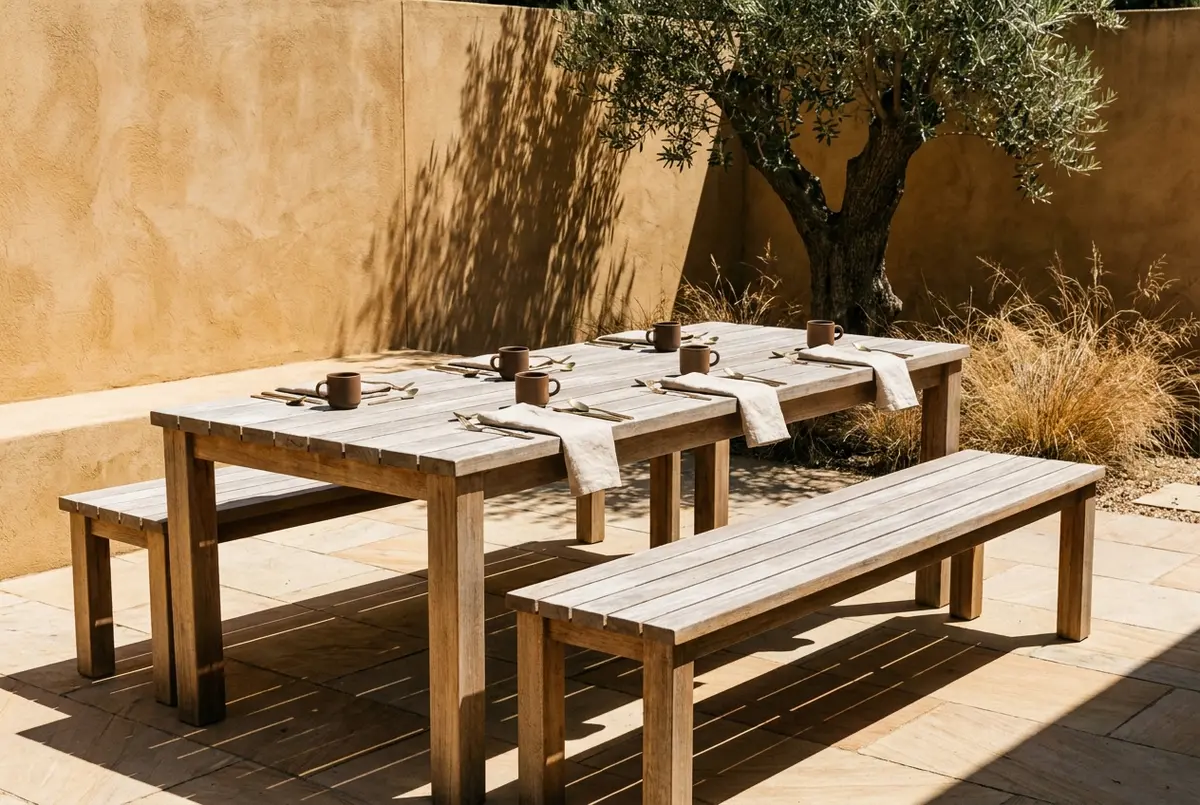
Custom outdoor timber furniture in Adelaide
Custom outdoor timber furniture in Adelaide costs $2,200 to $8,500, and most settings land between $3,200 and $5,500. Build time is 7 to 12 weeks. Only 5 species are worth building with here: spotted gum, blackbutt, ironbark, merbau and teak. Everything else fails inside 3 summers, and a solid glued-up top fails no matter what species it is cut from.
An outdoor dining table in this city has to survive 40 degree days, ultraviolet light that silvers a bare hardwood inside a year, and a wet-dry cycle far harsher than anything indoors. That rules out most of what a retailer will sell you. Below is which timbers cope, which joinery survives the movement, and why an oil finish is a subscription rather than a decision. For the indoor equivalent see custom dining tables, for the full species picture read the timber guide, and for what happens after delivery read caring for solid timber in an Adelaide home.
Species
What survives South Australian sun, and what does not
Prices are relative to spotted gum on the same setting. Natural durability classes are the published Australian above-ground ratings, and Class 1 is the top of the scale.
Spotted gum
BaselineClass 1 above-ground durability, dense, and tight-grained enough to resist surface checking under direct sun. Colour runs pale brown to deep red-brown across a single pack, which is either character or a problem depending on how it is laid out. The default for an Adelaide outdoor setting.
Blackbutt
Same to +10%Class 1 above ground, paler and far more consistent board to board than spotted gum, and available in long straight lengths. The right pick when you want an even colour across a 2,400mm top. Slightly softer, so it dents more readily under a dropped pot.
Grey ironbark
+15% to 30%The most durable of the group and the heaviest by a long way. A 2,400mm ironbark top is a genuine 3-person lift, which matters if the courtyard is through the house. Extremely hard on tooling, which is part of why it costs more to build.
Merbau
-10% to 20%Stable, easy to machine, dimensionally reliable and the cheapest credible option. It bleeds dark tannin for its first 2 wet seasons and will stain pale paving underneath it. Ask for certified stock, and expect to hose the paving after the first few rains.
Teak
+80% to 150%High natural oil content, almost no movement, and the only species in this list that genuinely needs nothing done to it. The price is the entire argument against it. Reserve it for a small piece where the cost delta is measured in hundreds rather than thousands.
The timbers that must not go outside
Tasmanian oak and Victorian ash carry Class 4 above-ground durability, which is the bottom of the scale. They are excellent indoor furniture timbers and they will be soft and stained inside 3 Adelaide summers if you put them on a patio. American oak is the same story. Untreated pine lasts a season. So does any board with an interior-grade glue line, which means standard MDF, particleboard and non-exterior plywood are all out, including as a hidden component in a leg or a stretcher.
The distinction that matters is between covered and exposed. A piece living under a solid roof on a verandah, out of driving rain and direct sun, survives on species that would fail in an open courtyard. Be honest with the maker about which one you have, because it changes both the species and the joinery.
Construction
Joinery that copes with a 40 degree day
Indoor furniture moves with humidity. Outdoor furniture moves with humidity, with rain soaking the upper face, and with a surface temperature that can run 20 degrees above the air temperature on a dark oiled top in February. The construction has to be built for that, and 4 details do most of the work.
Slatted tops, never a glued panel. A wide glued-up solid top outdoors cups, because the upper face dries and shrinks while the shaded underside stays damp. The stress travels to the weakest line, which is the glue. Build the top as individual slats screwed or bolted to the frame with a 5mm to 8mm gap between them. Each board then moves on its own, water drains instead of pooling, and leaf litter washes through.
Draw-bored mortise and tenon frames. A bolted frame that was tight in July is loose in February, because the steel does not shrink and the timber around it does. Draw-boring offsets the peg hole by 1mm so driving the peg pulls the shoulder permanently tight, and it holds mechanically rather than relying on clamping pressure or glue alone. It is the oldest answer to this problem and still the correct one.
Stainless fixings only. Grade 304 stainless is the minimum, and 316 is the right call within a few kilometres of the coast. Zinc-plated or galvanised screws react with the tannins in Australian hardwood and bleed black stains down the grain from every fixing point, usually within the first winter. That staining is permanent short of a full sand back.
Get the feet off the ground. End grain wicks water like a straw. A leg sitting flat on paving stays wet for days after rain and rots from the bottom up while the rest of the piece looks perfect. A stainless or nylon foot lifting the leg 5mm to 10mm off the surface, with the end grain sealed, removes the single most common failure point on outdoor furniture.
The hybrid option
A powder-coated aluminium or steel frame with a hardwood slat top is the most practical build for a fully exposed Adelaide courtyard, and it is not a compromise.
A marine-grade powder coat lasts 10 years plus with no attention. Aluminium does not rust at all, which matters near the coast, and it takes 20kg to 30kg off a large setting so 2 people can shift it to sweep underneath.
Expect $400 to $900 for the frame depending on size and finish. The timber budget then goes entirely into the top, which is the part anyone actually touches.
The one thing to specify: isolate the timber from the metal with a nylon washer or a butyl tape strip at every fixing. Wet hardwood in permanent contact with a coated frame is where the coating fails first.
Finish
Oil is a subscription. Silver is a decision.
This is the choice people regret most, and only because nobody told them what oiling actually commits them to. Pick the row you will genuinely keep up with.
| Finish | Re-coat interval | What actually happens |
|---|---|---|
| Exterior penetrating oil | Every 6 to 12 months | Holds the timber colour. West and north exposures need it at the 6 month end. Missing a cycle is not a disaster, it just fades back. |
| UV-stabilised exterior hardwax oil | Every 12 to 18 months | Costs more per litre and buys roughly double the interval. Still a maintenance commitment, just a lighter one. |
| Exterior film coating (marine or 2-pack) | Every 2 to 4 years | Longest interval and the worst failure mode. When it goes, it peels in sheets and needs a full strip and re-sand, not a re-coat. |
| Nothing. Let it silver | A wash once a year | Fully silvered in 6 to 12 months, then stable. Costs nothing and shortens nothing on a Class 1 timber. The honest choice for most people. |
| Powder-coated metal frame, timber top only | Frame: 10 years plus | Moves the maintenance onto a surface that does not need any. Only the slats need attention, and only if you want them to keep their colour. |
Silvering is not damage. Ultraviolet light degrades lignin, the natural binder in the wood, in roughly the top 0.1mm of the surface. Rain washes that degraded layer off and leaves pale cellulose behind, which is the grey you see. On a Class 1 hardwood, the timber underneath is untouched, the piece is exactly as strong as the day it was built, and a light sand brings the colour straight back if you change your mind in 3 years.
The practical test is honest rather than technical. If you will not spend a Saturday morning twice a year with a rag and a litre of oil, do not order an oiled finish, because a half-maintained oil finish looks worse than no finish at all: it goes patchy where the sun hits hardest and even where it does not. Choosing to let it silver from day 1 gives you a piece that looks deliberate for its whole life and costs nothing to keep.
FAQ
Custom outdoor furniture in Adelaide: common questions
What is the best timber for outdoor furniture in Adelaide?
Spotted gum, blackbutt and grey ironbark. All 3 carry Class 1 above-ground natural durability, they are dense enough to hold a fixing under thermal movement, and they are available locally in furniture-grade sections. Merbau works and costs less but bleeds tannin onto paving for its first 2 seasons. Teak is the benchmark and costs 80% to 150% more than spotted gum.
How much does custom outdoor timber furniture cost in Adelaide?
An outdoor setting runs $2,200 to $8,500, with most between $3,200 and $5,500 for a 6 to 8 seat table plus benches in an Australian hardwood. Build time is 7 to 12 weeks. A table on its own starts around $2,200. A powder-coated aluminium frame with a hardwood slat top sits at the lower end and weighs far less.
Do I have to oil outdoor timber furniture?
No, and choosing not to is a legitimate decision rather than neglect. An exterior penetrating oil needs re-coating every 6 to 12 months in Adelaide sun, which is a maintenance subscription for the life of the piece. Letting a Class 1 hardwood silver instead costs nothing, changes only the surface, and does not shorten the life of the furniture.
Why does outdoor timber go grey?
Ultraviolet light breaks down lignin, the compound that binds the wood fibres, in the top 0.1mm of the surface. Rain then washes the degraded material away and leaves bare cellulose, which reads as silver-grey. In full Adelaide sun a hardwood goes from new to fully silvered in 6 to 12 months. It is a surface effect, not rot, and a light sand takes the colour back.
Will a solid timber outdoor table crack?
A wide glued-up solid top outdoors will fail, usually within 3 summers. The top face bakes while the underside stays shaded and damp, so the panel cups, and the glue lines are the weakest path for that stress to travel. Build the top as separate slats with a 5mm to 8mm gap between them instead. The gap drains, lets each board move on its own, and never traps water.
When should I order outdoor furniture for summer?
Order by the end of winter. Build time is 7 to 12 weeks from deposit, Adelaide workshops fill their December slots by around August, and outdoor enquiries spike the first warm weekend in October. An order placed in October is a February delivery. An order placed in July or August lands in time to use it.
Keep reading
You might also find this useful
- Custom timber furnitureThe materials hub: which species suit South Australian conditions indoors and out, and what each adds to a quote.Read it
- How long custom furniture takes in AdelaideWhy an outdoor setting ordered in October arrives in February, and how to hit a summer deadline instead.Read it
- Furniture makers in AdelaideWho builds outdoor work here, how they quote it, and what to check before you commission one.Read it
Start here
Get your outdoor setting priced by Adelaide makers
Tell us the size, whether the space is covered or fully exposed, and roughly what you want to spend. We pass it to a local maker who builds outdoor work, and they quote you directly.
- Free to use. The maker may pay us a fee, you never do.
- Check the maker's ABN, insurance and completed Adelaide work before you commit.
- Adelaide metro only, so you are not sent to an interstate workshop.