Choosing a maker/7 min read
Caring for solid timber furniture in Adelaide
Direct sun through north-facing glass will bleach a tabletop unevenly within one Adelaide summer. Most timber furniture damage here is light and humidity, not wear.
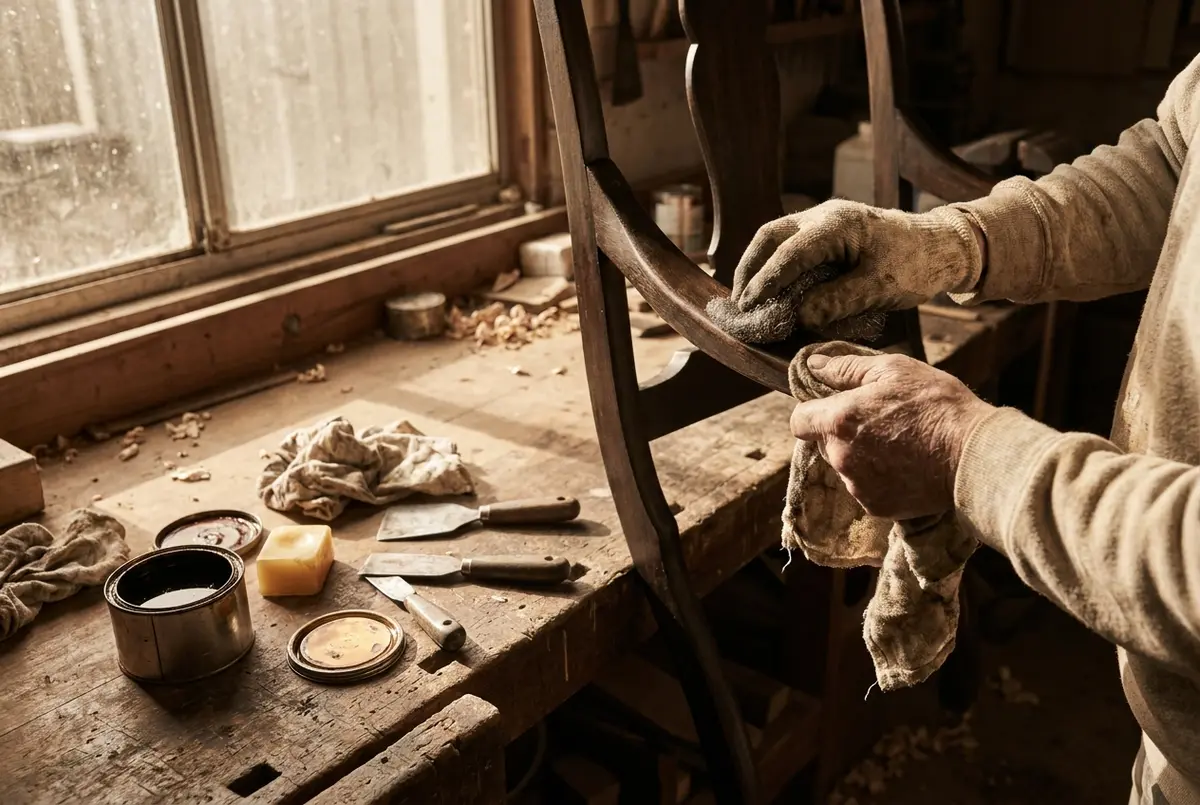
Ready to price something specific? See restoration in Adelaide or timber furniture in Adelaide.
Most damage to solid timber furniture in Adelaide is not wear. It is light and humidity, and both are avoidable. Direct sun through north-facing glass will bleach a tabletop unevenly inside a single summer, and the swing between a house running ducted cooling in February and the same house in July is enough to move a solid top several millimetres across its width. Neither is covered by a warranty, and neither takes any real effort to prevent.
Sun through north-facing glass
Adelaide extensions are glazed heavily to the north, which is correct for winter warmth and brutal on furniture.
Ultraviolet light breaks down both the finish and the timber underneath it. Most Australian hardwoods lighten and grey with exposure, but the problem is not the colour change itself. It is that the change happens only where the light lands. A bowl, a runner, a laptop or a stack of mail left in one place for a summer leaves a permanent shadow on the top, and the only fix is sanding the entire surface back and refinishing it.
3 things prevent it, in order of effectiveness:
- Do not place a solid top in unshaded northern or western sun. This is worth reorganising a room for.
- Fit a blind or a UV filtering window film. A film is the least intrusive and blocks the majority of UV without changing how the room looks.
- Rotate anything sitting on the top at least monthly through summer, and turn the piece itself end for end once a year if it is against a window. Avoid a permanent runner or placemat set, which creates the sharpest shadow line of all.
Humidity, ducted cooling and evaporative cooling
Adelaide is the driest mainland capital. Through February a house on ducted refrigerated cooling can sit under 30% relative humidity indoors for weeks at a time. Evaporative cooling does the opposite, pushing humidity up while it cools. A house that runs evaporative in December and refrigerated in February puts a solid top through 2 opposite conditions in a single season, and the timber responds to both.
Solid timber gains and loses moisture continuously and changes dimension as it does. Across a 1,000mm wide tabletop, seasonal movement of 5mm to 10mm is normal. A well-built piece allows it, which is why a good top is fixed with buttons, z-clips or elongated screw holes rather than screwed rigidly. The mechanism is explained in why solid timber tables split in Adelaide homes.
What you control is the environment:
- Keep pieces out of the direct path of a ducted outlet. A vent blowing dry, cold air onto one end of a table dries that end faster than the rest of it. 1 metre of clearance is enough, or redirect the vane.
- Do not leave a room sealed and baking. A closed-up Adelaide house on a 40 degree day exceeds 40 degrees inside, and that combination of heat and dryness is the harshest environment a piece will meet. Leave internal doors open so the house equalises.
- Do not chase a humidity number. Consistency beats any particular level. A room that sits at 35% all year does less damage than one that swings between 25% and 60%.
- Watch the shoulder seasons. Late March and early October are when the biggest swings happen. Bureau of Meteorology climate data for Adelaide shows how sharp the drop into summer is.
Cleaning: what to use and what to never use
The whole routine is a damp cloth and a drop of mild dish soap, wiped dry immediately. That is it.
| Product | Verdict | Why | | --- | --- | --- | | Damp cloth, dried straight after | Correct | Removes everything ordinary without wetting the timber | | A drop of mild dish soap in warm water | Correct for grease | Rinse with a clean damp cloth, then dry | | Silicone-based spray polish | Never | Leaves a residue that makes any future re-coat crater and fail | | Neat vinegar | Never on an oiled top | The acid dulls and strips the finish | | Methylated spirits | Never on shellac | Dissolves the finish on contact | | Mineral-oil furniture oil | Never over hardwax oil | Never cures, stays tacky and attracts dust | | Abrasive cream cleaner | Never | Cuts through the finish before it removes the mark | | The maker's own oil | Correct for maintenance | Matches what is already there |
The silicone rule is the one to remember. Contamination stays invisible until a refinisher tries to re-coat the piece and the new finish craters, and the repair is then a full strip.
Use coasters and trivets. Standing water and heat are the 2 things that damage every finish in the finishes guide.
Re-oiling intervals
If the piece has a hardwax oil finish, this is the entire maintenance schedule.
| Piece | Interval | Time it takes | | --- | --- | --- | | Dining table in daily use | 12 to 24 months | 1 hour plus overnight cure | | Desk | 18 to 30 months | 1 hour plus overnight cure | | Coffee table | 24 to 36 months | 45 minutes plus overnight cure | | Buffet or sideboard | 3 to 5 years | 2 hours plus overnight cure | | Bedhead | 4 to 6 years | 1 hour plus overnight cure | | Timber benchtop near a sink | 6 to 12 months | 1 hour plus overnight cure | | Outdoor setting, exterior oil | 6 to 12 months | 2 hours plus 24 hour cure |
The method: clean, dry, cut back lightly with a fine abrasive pad along the grain, wipe the oil on thinly, leave it 15 minutes, then wipe all the excess off. Too much oil leaves a sticky film and is the common mistake. Lay used cloths flat outdoors to dry before disposing of them, because oil-soaked rags generate heat as they cure.
A film-finished piece, meaning polyurethane or lacquer, needs none of this. It gets cleaned and left alone until the film eventually fails, at which point the panel is re-sanded and re-coated by a workshop. Most fitted cabinetry in an Adelaide house is finished that way, which is 1 of the practical differences between fitted and freestanding work set out in cabinet maker, furniture maker or joiner.
Water rings, heat marks and what is recoverable
| Mark | What it is | Recoverable at home? | | --- | --- | --- | | White or cloudy ring | Moisture trapped in the finish | Yes. Cut back lightly and re-oil | | White heat bloom | The finish softened under a hot dish | Usually. Same treatment | | Dark or black ring | Water reached the timber and reacted with tannins | No. Needs sanding into the surface | | Fading or bleaching | UV exposure | No. Needs a full sand and refinish | | Scratch through an oiled finish | Surface damage only | Yes, in 10 to 30 minutes | | Scratch through a lacquer or poly film | The film is breached | No. The whole panel is re-sprayed | | Silicone haze or craters | Polish contamination | No. Strip and refinish |
Act on rings within a day or 2 and almost all of them come out. Left for a month, a white ring frequently becomes a dark one as the moisture works deeper.
Anything in the "no" column is a job for a restorer rather than a rag. Furniture restoration in Adelaide covers what repair, re-gluing and refinishing cost and when a piece is worth it.
Moving a piece without wrecking it
Lift from the frame or the base, never by the top. A tabletop is designed to move relative to its base, which means the fixings holding the 2 together are deliberately not rigid. Picking a table up by the edge of its top puts every kilogram of the base onto those fixings, and it is how a top gets pulled loose or split at a button slot.
3 more rules, all learned the expensive way:
- Never drag. Lift it. Dragging a table across tiles snaps legs at the joint and dragging a cabinet racks the carcase out of square.
- Empty drawers and remove shelves first. A loaded buffet weighs half again what it looks like, and a sliding drawer changes the balance mid-lift.
- Carry long tops on edge, not flat. A 2,400mm top weighs 60kg to 90kg, flexes badly carried flat, and will not turn on a villa staircase in either orientation. Measure the narrowest doorway and any stair landing before you start.
Use felt pads on hard floors and check them yearly. A grit-loaded pad does more damage than no pad at all.
Choosing a maker who builds for this climate removes most of the risk, and the checks that identify one are in how to choose a furniture maker in Adelaide. Species matters too, and that sits on custom timber furniture in Adelaide.