What it costs/11 min read
What custom furniture costs in Adelaide
A custom dining table in Adelaide runs roughly $2,800 to $9,000. Here is what sits behind that range, piece by piece, and the 6 decisions that move the number most.
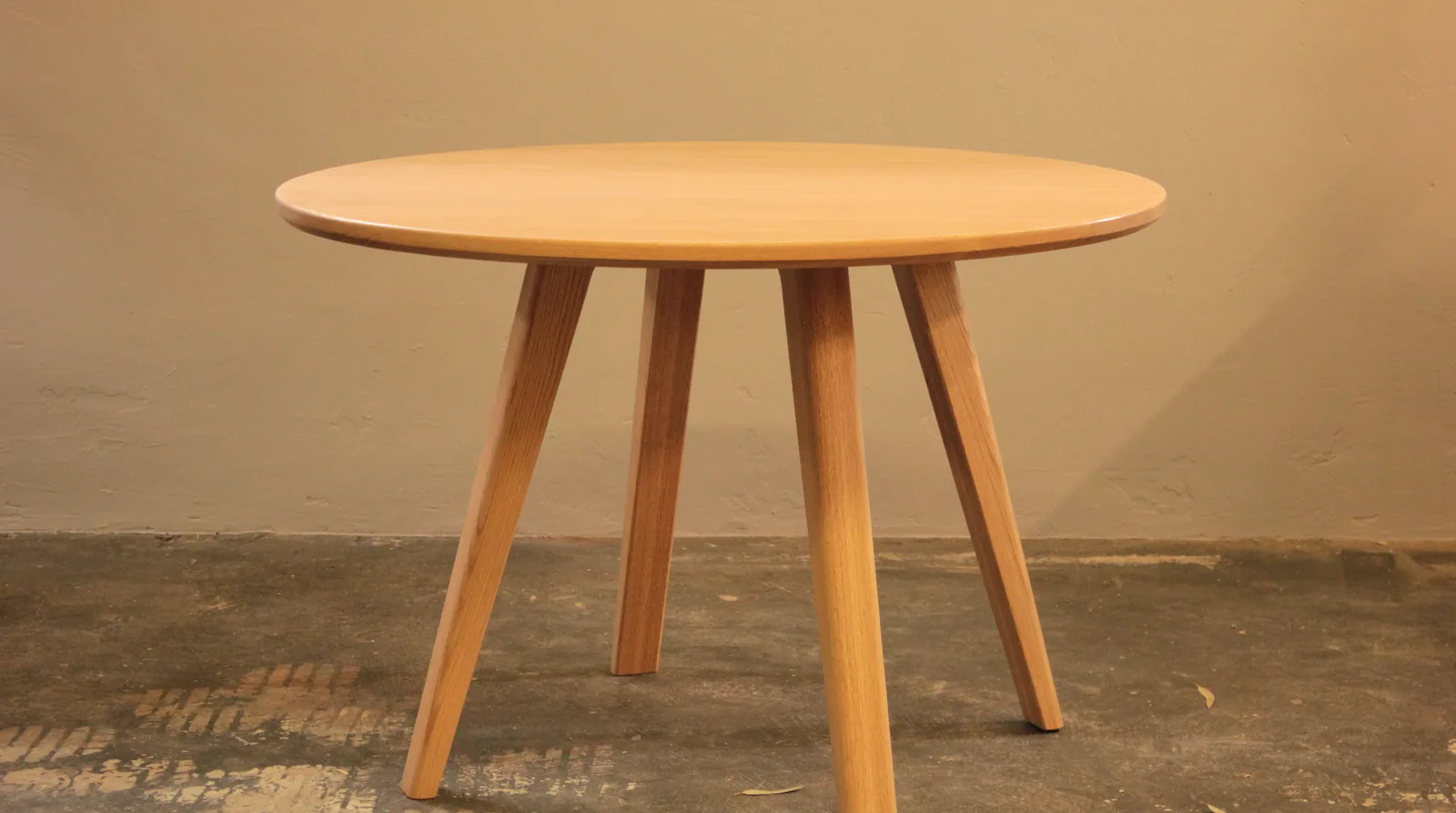
Ready to price something specific? See dining tables in Adelaide or wardrobes in Adelaide.
Most people asking this question have already had one quote that felt high and one that felt suspiciously low, and no way to tell which was the honest one. The bands below are what custom work genuinely costs in Adelaide in 2026, and more usefully, what sits behind the number.
The price bands, piece by piece
These are total delivered prices for solid timber construction from an established Adelaide workshop. They assume a standard local hardwood, a hand-applied finish and metro delivery.
| Piece | Typical range | Where most land | | --- | --- | --- | | Bedhead | $900 to $2,400 | $1,200 to $1,600 | | Coffee table | $1,200 to $3,500 | $1,600 to $2,200 | | Desk | $1,600 to $4,500 | $2,200 to $3,000 | | Entertainment unit | $1,800 to $5,500 | $2,600 to $3,600 | | Dining table | $2,800 to $9,000 | $3,500 to $5,500 | | Buffet or sideboard | $2,400 to $7,000 | $3,200 to $4,500 | | Outdoor table setting | $2,200 to $7,500 | $3,000 to $4,500 | | Built-in wardrobe | from $2,600 per linear metre | $2,600 to $4,200 per metre | | Fitted joinery run | from $3,500 | $6,000 to $15,000 |
There are 2 things about that table that matter more than the numbers themselves. Fitted work is quoted per linear metre because the cost is driven by how much wall it covers. Freestanding work is quoted per piece because the cost is driven by timber volume and joinery hours. Comparing the 2 on a per-dollar basis is meaningless, and it is why a wardrobe quote and a table quote for similar money represent completely different amounts of work.
The 6 decisions that actually move a quote
1. Timber species (the biggest lever by far)
This is where the money is, and it is the decision most people make last. Rough ranking of cost for the same piece, using Tasmanian oak as the baseline:
- Tasmanian oak or Victorian ash: baseline. Pale, straight-grained, stable, and the workhorse of Australian furniture making.
- American oak: roughly 15% to 25% above baseline. Imported, extremely consistent, popular for a reason.
- Blackwood: roughly 35% to 55% above baseline. Warm mid-brown, beautiful, and the species most Adelaide makers will steer you toward for a feature piece.
- River red gum or figured stock: 60% to 120% above baseline. Dramatic, but the waste factor is brutal and the drying is slow.
- Recycled or reclaimed: usually 20% to 60% above baseline, not below it. See why recycled timber costs more, not less.
If a quote comes back higher than you hoped, changing species is almost always the most effective single change you can make. Changing the size is not.
2. Solid versus veneered
A solid timber top and a veneered top can look nearly identical on delivery day and cost 40% apart. Veneer over a stable substrate is not automatically the cheap option, and for wide cabinet doors it is genuinely the better engineering choice because it will not move. For a dining tabletop that will be sanded back twice in its life, solid is the right call. Ask which you are being quoted, because a low quote is very often a veneered quote.
3. The base or carcase design
A 4-leg table with mortise and tenon joinery is the cheap end. A pedestal base, a trestle with a stretcher, a cantilevered top or a steel and timber hybrid all add hours. On cabinets, the equivalent lever is drawers: every drawer is a small box built inside the box, and soft-close runners at a decent grade cost real money. A buffet with 4 drawers instead of 2 doors is typically 25% to 35% dearer.
4. The finish
Covered properly in our finishes guide, but as a cost lever: a hardwax oil finish is cheaper to apply and repairable at home. A high-build catalysed lacquer costs more, resists more, and cannot be spot repaired. Neither is wrong. The mistake is picking the cheap finish for a family dining table and the expensive one for a bedhead nobody touches.
5. Size, but less than you think
Going from a 1,800mm dining table to a 2,400mm one adds roughly 15% to 20%, not 33%. The setup, the joinery, the base, the sanding and the finishing are near identical, and only the timber volume moves. Order the size the room actually takes, which is a different number from the size you assume it takes. See how to measure for a table.
Extension mechanisms are the exception. A butterfly or draw-leaf extension adds $600 to $1,800 depending on the mechanism, because it is a second piece of precision engineering hidden inside the first.
6. Delivery and access
Almost nobody asks about this and it bites regularly. A 2,400mm solid top weighs 60kg to 90kg. If it has to go up a staircase, through a 820mm doorway, or around a tight landing in a Norwood villa, the maker either builds it in 2 pieces, brings a second person, or cannot do it at all. Measure your narrowest access point before you order, not after.
What the money is actually buying
A useful way to sanity-check a quote is to work backwards through it. On a $4,500 dining table from an Adelaide workshop, roughly:
- $900 to $1,400 is timber, bought rough-sawn, with 30% to 40% of the board lost to machining, defect and offcuts you are still paying for.
- $250 to $500 is finish, abrasives, glue, hardware and consumables.
- $2,200 to $2,800 is labour, at 35 to 50 hours across milling, joinery, assembly, sanding and 3 to 5 coats of finish with cure time between each.
- The remainder is workshop overhead, insurance, delivery and margin.
There is not much fat in that. When a quote comes in dramatically under the band, the saving has come out of the timber (thinner, veneered, or a lower grade), out of the joinery (screwed and plugged rather than cut), or out of the finishing hours (2 coats instead of 5). Those are legitimate ways to build to a budget. They are only a problem when nobody tells you that is what happened.
The Adelaide-specific cost that nobody quotes for
Every guide to furniture pricing on the internet stops at the paragraph above. Here is the part that only matters in this city.
Adelaide is the driest mainland capital. Through February, a house running ducted refrigerated or evaporative cooling can sit under 30% relative humidity indoors for weeks. A solid timber top that was glued up at a higher moisture content will shrink across its width in that environment, and it will do it unevenly, and the glue lines will open.
The relative humidity records behind that are public, and the Bureau of Meteorology publishes them at bom.gov.au. Adelaide's summer figures are the reason a maker here has to work differently from one in Sydney or Brisbane.
Building for that costs money that does not appear as a line item. It means the maker holds timber in a conditioned space for weeks before machining, checks moisture content with a meter rather than by feel, and detail-designs the top so it is free to move: a breadboard end that is pinned and slotted rather than glued across its length, buttons or z-clips instead of screws through the frame, and a finish applied to the underside as well as the top so both faces breathe at the same rate.
A workshop that does this has a higher cost base than one that does not, and their quote will be higher. That gap is the single most valuable 10% you will spend. We have written up why tables split in Adelaide homes in full, because it is the most common avoidable failure in this market and the one question that separates makers fastest.
How to use a quote comparison properly
Get 2 or 3, and compare these lines rather than the totals:
- Species and whether the top is solid or veneered. If one quote does not say, ask. This alone explains most large gaps.
- Top thickness. 32mm and 45mm are different tables. A thin top on a long span will telegraph its supports over time.
- How the top is attached to the base. The answer should involve the word "movement". If it involves screws straight through a fixed rail, keep looking.
- Number of finish coats and the product used.
- Deposit, balance timing and what happens if the delivery date slips.
- What the warranty covers, and specifically whether it covers movement.
A maker who answers all 6 clearly and quickly is telling you something about how they run a job. A maker who is vague on 3 and 4 is usually the cheap quote, and the reason will surface in year 2.
Where to go next
If you have a specific piece in mind, the pricing detail lives on the piece pages: custom dining tables is the most detailed, and built-in wardrobes covers the per-metre model properly. If you are still deciding between species, the timber guide is the place to start.